Saturday, September 3, 2011


A season saturated with Borussia photos, that was 1974-75. May be their finest season, but it was increasingly West German scene anyway. The UEFA Cup produced little surprises at first, except for the early exit of the English clubs. So far the third European club tournament has been English domain – now only Derby County managed to reach 1/8 finals and no further. Velez (Mostar) eliminated them, as to confirm the crisis of English football. When the ½ stage arrived it was a manifestation of new order in the European football: Juventus was the only ‘traditional’ club. Two West German had to play against each other and the forth – meeting the Italians – were Dutch. Perhaps this was the greatest hour of Twente (Enschede) – they won both legs against Juventus. Not to be outdone, Borussia also won both matches against 1. FC Koln. As for results, they were exactly the same: Twente won 3-1 and 1-0 in Torino. Same results in favour of Borussia, although in reverse: they won 3-1 visiting Koln and managed 1-0 on home turf. May be that was the important difference at the end, but before the finals one thing was sure: the UEFA Cup final was just a smaller version of the World Cup final a year earlier. May be Dutch victory this time? After all, they were up and coming and Borussia were already established name somewhat lacking international success. One more thing was equal – both finalists hailed from small towns and had small stadiums. Borussia, hosting the first leg, preferred to play it at Dusseldorf. Twente on the other hand played at their even smaller than Borussia’s stadium the second leg. The first match ended 0-0, Borussia playing surpising nominal 4-4-2 and unable to score. Looked like Dutch revenge for the lost World Cup final was coming. But one had to pay closer attention to Borussia’s earlier performances: they appeared to be more comfortable when visiting and their hosts were obliged to play open football. In Enschede Borussia played 4-3-3 – more attacking version than at home. By the 60th minute they were leading 4-0 and the Cup was already theirs. It was 5-1 at the final whistle. Was it a challenge really? Borussia won so easily. To a point, this final spelled out the end of Twente – they never became the forth great Dutch club and faded away. As trivia goes, it had been Germans scoring on compatriots – Twente’s goalkeeper Gross was a West German import. Arnold Muhren, sold by Ajax to Twente continued his misery as a substitute player. Was he an empty promise? Just wait 5 more years. Then add 8 more, but at 1975 he looked like doomed to failure. Stielike was still young and shaky, but Simonsen was already a bright star. Three goals by Heynckes and 2 by Simonsen – one more trophy for the Germans.
For Twente – sweet memories and their squad on the the program:
Final 1st Leg, Rheinstadion, Dusseldorf, 7 May 1975, att 42000

Borussia Monchengladbach (0) 0 FC Twente '65 (Enschede) (0) 0

Borussia Monchengladbach
Kleff; Wittkamp, Stielike, Vogts, Surau; bonhof, Wimmer, Danner
(Del'Haye), Kulik (Schaffer); Simonsen, Jensen
FC Twente '65 (Enschede)
Gross; Drost, Van Ierssel, Overweg, Oranen; Thijssen, Pahlplatz,
Van der Vall, Bos; Jeuring (Achterberg), Zuidema


Final 2nd Leg, Diekman, Enschede, 21 May 1975, att 21000

FC Twente '65 (Enschede) (0) 1 Borussia Monchengladbach (2) 5
2' 0-1 BM: Simonsen
9' 0-2 BM: Heynckes
50' 0-3 BM: Heynckes
60' 0-4 BM: Heynckes
76' 1-4 Tw: Drost
86' 1-5 BM: Simonsen (pen)
Monchengladbach won 5-1 on aggregate

FC Twente '65 (Enschede)
Gross; Drost, Van Ierssel, Overweg, Oranen, Bos (Muhren), Thijssen,
Pahlplatz (Achterberg), Van der Vall, Jeuring, Zuidema
Borussia Monchengladbach
Kleff; Wittkamp, Vogts, Surau (Schaffer), Klinkhammer; Bonhof,
Wimmer (Koppel), Danner; Simonsen, Hensen, Heynckes
German goal in German net.
Heynckes scores his second for the night.
Simonsen makes it 5 from a penalty. Gross is helpless.
And Berti Vogts lifts the UEFA Cup.
First international trophy for Borussia – today UEFA Cup, next year the European Champions Cup? Very likely, with a squad like this. As for the Dutch, there will be some cup lifting too, alas, only for two players – Thijssen and Muhren.

Wednesday, August 31, 2011


From amateur leagues to world class Bundesliga - on every level West German football was THE FOOTBALL in 1974-75.
A glimpse of the season:


And the German football was to place to be as well – the thrill was huge: from legendary players like Karl – Heinz Schnellinger relegated to Borussia Moenchengladbach champions again. Snow, slush, great grass, penalties, heavy tackles, superstars arguing with referees… the present was German and the future – without a doubt German too.

Monday, August 29, 2011


With Bayern so weak, the German championship was open for grabs? Not so. It was predictable champion: Borussia Moenchengladbach won their third Bundesliga title. Looked natural. It also looked like that Borussia were progressing constantly: by 1975 their coach Hennes Weissweiler was no longer a guy with difficult to pronounce name, but one of the top world coaches, known to all and sundry. Winning was the name of his game.
After the match with Eintracht Braunscweig and Jensen scoring, Berti Fogts shows to the public the German champion shield.
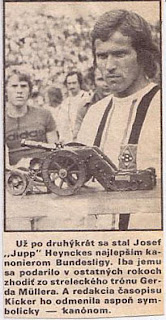
Jupp Heynckes got the gun as the top goalscorer of the championship.
Top, left to right: Hennes Weissweiler –coach, Henning Jensen, Hans Posner, Gunter Kostner, Hans-Jurgen Wittkamp, Josef Heynckes, Christian Kulik, Dietmar Danner, Hans Klinkhammer, Frank Schafer, Horst Koppel, Stock – masseur.
Sitting: Ulrich Surau, Allan Simonsen, Karl del’Haye, Bertie Fogts, Wolfgang Kleff, Hans Quasten, Ulrich Stielike, Rainer Bonhof, Herbert Wimmer, Roger Roebben.
By now, Borussia were firmly established as the second best German club, the constant rivals of Bayern. They were also considered the alternative of Bayern – a maverick team, devoted to free, almost wild, attacking football, unlike to measured, disciplined, and stiff brand of the Bavarians. Borussia were thought to be the team scoring madly, a main part of the legend about them. They scored plenty, but… usually Bayern scored more goals. So far, 1974-75 was the highest scoring season for Borussia - 86 goals! Alas, even now they were not the bst scorers – third placed Eintracht Frankfurt bested them with 89. So much for the legend, but Borussia were really dedicated to endless attack – unlike Bayern’s, their defense was the weakest line and allowed considerable goals against Borussia. 40 in the winning season – more or less, Borussia depended on outscoring the opposition: about 2 goals for 1 received. The mavericks were not really mavericks, but one thing they did much better than Bayern: they replaced players better, and with the years the squad as getting increasingly stronger.
If Bayern became a superclub, Borussia were relatively small one and this difference shaped club policies in favour of Borussia. Bayern was buying high profile players, but never as big as their secret superstars. Borussia had to sell and buy cheap replacements. To sell Beckenbauer or Muller was almost unthinkable in Munich. In Moenchengladbach there was no such stigma – cash was needed, so Netzer was sold without fuss – his absence opened room for younger unknowns. One result was the performance of imported players: when Torstensson and Andersson came to Bayern with considerable fame, but played erratically and somewhat not up to expectations, Borussia acquired 2 young unknown Danes – Simonsen and Jensen. Both not only established themselves as starters, but constantly improved their game. By 1978 people hardly remembered Bayern’s Swedes whether Borussia’s Danes were world famous strikers, eventually ending in Barcelona and Real Madrid. And they were not alone.
Like Bayern, Borussia depended on cluster of big stars – Fogts, Heynckes, Wimmer, Kleff. There were players close to the European and World champions and often included in the national team – Koppel and Danner. There were supportive workaholics like Wittkamp, Kulik, and Surau. But there was a lot of young talent, aiming on stardom: Bonhof already established himself in the national team and certainly was a star, but others were pushing too – apart from the two Danes, there was Stielike. There was Del’Haye. May be Klinkhammer. In a way, the departure of Netzer provided opening for a very fruitful policy: nobody was untouchable and, therefore, youngsters had very good chance for a starting place. Rummenige had to wait until Muller decided to leave Bayern – Simonsen did not have to wait for anybody. If anything, Simonsen had to watch his back for equally young Del’Haye… which motivated the Dane to get increasingly better.
Policy apart, Borussia appeared better balanced team than Bayern – goalkeeping and defense were bellow Bayern’s standards, yet, good enough. Midfield hardly suffered from the absense of Netzer – there were Wimmer, Bonhof, and – increasingly stronger Stielike. In contrast, Bayern really had only Hoenes and may be Kapellmann. In attack – Bayern depended on Muller. Borussia had Simonsen on the right wing; Jensen as a centre-forward; and Heynckes on the left wing. If anybody was coming close to Gerd Muller at the time, he was Heynckes, consistently scoring about 30 goals a season. Younger, eagerer, freer Borussia seemed to be the better present – and future – of West German football. They were still to win titles – coached by Udo Lattek, who replaced Weissweiler after the end of the season. Weissweiler went to Barcelona and Lattek had a good laugh at Bayern’s expense, but it was a bit later. For now – Borussia collected third title and was getting ready for more.

Saturday, August 27, 2011


And somebody had to come big, for mighty Bayern was coming small… they finished measly 10th! Beckenbauer and all – 10th. The lowest place Bayern had since they burst into the Bundesliga. Their lowest finish so far was 6th place in 1966-67, their second season in the top league. Udo Lattek approached the Bayern’s President Wilhelm Neudecker and, concerned, told him ‘we need some changes’. The President was in agreement: ‘You are right! We need changes – you are sacked!’ By Beckenbauer’s suggestion Dettmar Cramer replaced Lattek. The irony of it… once upon a time Lattek was assistant of Cramer. The former assistant went to Borussia Monchengladbach – and won the next two championships. Bayern was not to see a new title any time soon…
The summer of 1974 – world champions, solid, ready for another season of winning… Breitner departed, but the rest was at hand. In January 1975 Lattek was out and Cramer in. But Lattek had been right: Bayern needed a change. Squad change rather than coach change. For 10 years now the Bavarians depended on cluster of superstars, supported by more or less middle of the road players. New talent was exactly making waves – compared to the great Ajax, Bayern did not produce a whole team of world class stars. Hoenes and Breitner, yes, but after them only Rummenige and he was yet a questionable quality. Breitner left, Hoenes was increasingly fragile – his constant injuries eventually finished his career early. It was still Maier, Beckenbauer, Schwarzenbeck, and Muller – just like 10 years ago. The two Swedes – Torstensson and Andersson – were inconsistent. So was the occasional national player Wunder. Zobel was hardly great midfielder, far more limited than Overath for instance. The cluster of superstars was added by sturdy Hansen, Roth, and Durnberger, but they were support players at best. Unlike Borussia Moenchengladbach, Bayern was unable to replace players with younger and better ones, especially when foreigners were the case. By 1975 faced problems similar to those of Real Madrid, Inter, Milan – a change was needed, but was it possible to replace aging superstars dear to the fans and still performing strong. Unlike the Spanish and Italians, Bayern had additional difficulty: the aging stars were not retiring yet; on the contrary – they were in great form. Let go Beckenbauer and Muller? The current best player in the world and goal scoring machine? Clean sweep was difficult at best, with few additional problems: the first was Rummenige, still in secondary role – unfortunately, he played at the same position as Muller. The other was Beckenbauer – with him on the pitch, who really needs another playmaker. True enough, yet this limited Bayern to some degree: the strongest line of the team was the defense, including the goalie. Attack was increasingly reduced to Muller – no wingers really impressed and survived for long. The midfield, with injury prone Hoenes, was hardly imaginative force – instead, it was increasingly becoming the prototype of the German modification of total football: mobile, tough, disciplined steamroller without any spark of creativity. No wonder Roth was very stable and decisive player – always dependable, running as hell, and possessing no imagination whatsoever. But was it obvious? Hardly so – after all it was not even Roth, but Durnberger who embodied the new German football: Durnberger played at any post – he was attacker, midfielder, defender, always in the team, yet, somewhat a substitute, patching holes. Great player he was not… dependable – yes. But he was hardly the kind of player to replace a Beckenbauer and shine on his own.
The ‘steamroller’ kind of football worked against European teams and Bayern was winning at the large stage. At home the brand did not work – on one hand, all German teams were playing the same kind of football by now and the likes of Roth and Durnberger were matched by almost every German club: tough runners clashed with tough runners. On the other hand, the cluster of superstars were very familiar at home – for steady ten years they were more than familiar to the opposition, and most clubs learned how to neutralize them. Younger feet were killing the getting older Beckenbauer and Muller. It was not enough to win at home anymore. In ten years time Bayern became a superclub except having superteam… yes, there were 5 world champions, but Roth, Durnberger, Zobel had no chance to be included in the national team and their kind of player was increasingly shaping Bayern. A radical change was needed, and radical change was impossible… at the end Lattek was fired, the players stayed, Bayern finished measly 10th and the hardship was not over at all. Unfortunately, Bayern shaped the future of football – the awful game of the 1980s. Ironically enough, it was Beckenbauer voicing concerns for the future of the game, yet, he has not listen to and more importantly – his very presence in Bayern killed options for radical change.

Wednesday, August 24, 2011


At the end, the most likely candidates for greatness were Fortuna Dusseldorf and Eintracht Frankfurt. The Dusseldorfers finished merely 6th, but already were detected. So far their climb was quite, but steady.
Fortuna did not have particularly great stars, but Seel, Herzog, and Zewe were already playing or at least considered for the national team. The rest was trurdy bunch without much flair, but well shaped, experienced, and ripe. Close to Hertha really, as far as the quality of the squad was concerned, but unlike Hertha, it was already built team. There was not a change of generations lurking dangerously, as in Koln; there was no shaping of a team, as in Hamburg. Fortuna were only to get better and likely candidate for greatness – there time was ‘now’. May be a player or two, and – harvest time.
But the likeliest of all was Eintracht Frankfurt. Steadily at top, finishing 3rd this year. It was all – the German Cup was won in 1974 and was kept in Frankfurt in 1975 as well. Eintracht beat MSV Duisburg 1-0 at the final, proving winning spirit.
Cup winners second year in a row. Bronze medals from the championship. What could be next? A title? European cup? Eintracht were the best candidate to become the third great German club – able coach – Weise; megastar World Champions Grabowski and Holzenbein; young, but experienced candidates for the national team – Nickel, Korbell, Trinklein; well respected and dependable players like Kunter (always written Dr. Kunter!), Beverungen… Experience, energy, selection – Eintracht had everything. Just wait the new season to start. They were coming big. At least it was thought they were coming big.

Monday, August 22, 2011


Hamburger SV and 1. FC Koln were not potential candidates either: the Hamburgers were getting out of their late 60s crisis, but great they were not yet. It was good that they were recovering and may be after a few years of development they could challenge Bayern and Borussia M. Not now.
Much more promising than Hertha – but still in need of work. Some were getting recognition – the coach Klotzer, Kaltz, Kargus, Nogly, Volkert – but were not ripe so far. Others were nearing retirement – like the legendary Turk Ozcan. It was still a team in between.
1. FC Koln was slightly different: unlike HSV, they were stable performers, without really able to compete for the title.
Solid team, coached by a legend – the maker of Bayern, Zlatko Cajkovski. Overath, Weber, Cullmann, Flohe, Lohr provided class – three fresh World Champions were no joke. There was some additional promise too, but the problem was that the key players – Overath and Weber were nearing retirement and Flohe and Cullmann were not at the same class. The team was entering the critical moment of changing generations and the future was looking rather grim, if goalkeeping was a sign enough. The club was unable to find reliable goalie… the most suspect and shaky candidate was one Tony Schumacher. That’s right: arguably the best keeper of the 1980s was… a flake.

Saturday, August 20, 2011


The disgrace of VfB Stuttgart brings the question of the possible third big German club. Internationally, West German football ranked best. It was natural to produce more than two top clubs – which so far did not happen. Instead, something different happened – the champions of the early years of the Bundesliga not only did not repeat their first success, but rapidly faded. Only the ‘newcomers’ – Bayern and Borussia M – got better and stable. There was to be at least more great club, though… in the early 1970s Schalke 04 was on the verge of greatness. The flight was cut short by the bribing scandal in 1971 and although penalties were short, and by 1975 every guilty player was already on the pitch, Schalke 04 not only did not recover, but was entering a crisis. The search continued, alas, year after year there was a club playing well one season only to disappoint the next. However, there was hope in 1975 – Hertha finished 2nd; Eintracht Frankfurt – 3rd; Hamburger SV – 4th; 1. FC Koln – 5th; and Fortuna Dusseldorf – 6th. Sifting them carefully, potential third strong club was more than possible.
Perhaps not Hertha. It was hoped that the West Berliners would be strong, but they had checkered history so far – even relegation. Not it looked like they were rising, but it was too early to be sure.
It was still unshaped team – solid, yet, not stellar players. The seeds of better team were the Swede Magnusson, the former German national goalkeeper Wolter, and the increasingly getting better striker Beer, already attracting the eye of Helmut Schon. But it was a team in need of acquiring more top players and shaping into stronger squad. Probably in few years time; not now.