Monday, November 7, 2011


It was mainly matches at home, ending in ties:
2-2 against Poland.
Deyna shoots, Varadin is late to block, Viktor getting ready to dive, but the ball seemingly is off target.
A penalty against Poland. Tomaszewski protested the penalty against Gorgon, but he saved Masny’s kick.
Jozef Moder tackled by Hungarian defender in Budapest. If anything, the match with Hungary was played on better pitch, but 1-1.
Fighting the mud along with DDR to another tie. Weisse strikes somehow, Gogh is too late to prevent.
After the mud came the snow and Romania.
Pivarnik (left) and Masny unable to penetrate Romanian defense.
Pivarnik in attack – never mind the snow, he displayed the qualities of modern full back – that is, joined the strikers.
Svehlik escapes from Angelini’s tackle.
Nehoda strikes and Sandu can only watch.
But – 2-2 at the end.
And from the snow to the lake:
Dobias, Sajanek, Matvienko, and Konkov in the water just about a month before their official meeting in the European ¼ finals. CSSR – USSR: 2-2.
Not pretty pictures, not pretty results… why bother following Czechoslovakia in their fantastic friendlies against unexciting opponents? But it was in these games the team solidified and built character.
Panenka was praised in the snow: commentators said that he finally started playing for the national team the way he played for his club. He was not English-type player, so it was really something to get noticed when playing in impossible conditions. Closer attention should have been paid to development of Czechoslovakia in the mud, swamps, and snow – they were not winning, true. They were missing penalties, true. When summer arrived, they managed ties again – but won at the end in extra time and by penalty shoot-out. To my mind the string of friendlies was the key to the Czechoslovakian success.
One thing after major tournament is ‘lessons’… what new brought the tournament. The European finals actually brought nothing new. No innovations. Rather, it was obvious that total football spread and it was the norm. The formula of success was building well rounded team capable of playing total football and preserving excellent condition. However, hardly any new major stars emerged – the new European champions were just a lesser version, yet, very competent, of the great innovators from few years back. CSSR truly depended on collective game, more or less every player participated equally, and the importance of the defenders was reinforced: it was not the strikers scoring the important oals, but back-liners, surprising the opposition. The game was becoming tougher, though – traditionally mellow and technical team, CSSR suddenly displayed gritty pressure on the whole pitch. It was confirmed that not individual stars, but collective effort made a winning team – the age of great individuals was seemingly over.

Saturday, November 5, 2011


The last sense of repeating the past in the championship full of repetitions: Czechoslovakia evoked Poland of 1974. There were important similarities – both countries surprised the world by eliminating England. Both were expected to expire quickly after incidental advance, but both stunned the world by continuing ahead with great performances. Both countries carefully and slowly built their teams. Both had great and long lasting head coaches. Both had capable assistant coaches, becoming famous on their own. Both countries were not exactly innovators, but adapted very well useful elements of total football into their game, in accord with the abilities and peculiarities of the available players.
Yet, they were not identical and differences were just as many: Czechoslovakia had old reputation and Poland did not. Czechoslvakia was considered - and rightly so – in a decline since 1970. Poland was so unimportant, decline was not really a consideration – rather, then came out from nowhere. Czechoslovakia managed a revival. Traditionally, Czechoslovakian club football was stronger than the Polish one, and the pool of talent was more numerous and had more depth. Poland depended on lightning attacks, but the Czechoslovaks employed various tactics – they were very confident in defense; were able to change the tempo – or to adjust to changing tempo; they were more patient and careful.
Overall, both countries had strong and well balanced teams, with strong stars in every line. To a point, the Poles had better strikers. To a point, the Czechoslovaks had more dangerous defenders participating in attacks and often scoring the goals. However, the best advantage of both countries was that hardly anybody took them seriously – until it was too late. They were able to become lethal out of sight.
So what happened? By 1972 the Czechoslovaks were still licking their wounds from the disastrous 1970 World Cup. A new team was needed – and there was none. Meantime Poland won the 1972 Olympic games, and after that the squad was just finely tuned and shaped with careful additions. CSSR started from scratch at that year: Vaclav Jezek and appointed head coach of the national team. Jozef Venglos was made his assistant. Both coaches were peculiar for East Europe: Jezek came straight from Holland, where he coached ADO Den Haag since 1969. He managed to take his humble club to third place during the time of great Ajax. If anything, he learned about total football right from the source. Venglos did not even start his coaching career in Czechoslovakia – he ventured into coaching in 1966 and in Australia, eventually becoming the coach of the national team. He returned to his native land in 1969 and in 1973 he became the coach of Slovan Bratislava. He was still the club coach in 1976, combining club work and the national team. It is important to mention that Slovan were strong during that time – and the credit goes to Venglos. Slovan became the backbone of the national team with mainly Slovak additional players, for those were the years of Slovak domination anyway. Vencel, Pivarnik, Ondrus, Jozef Capkovic, Svehlik, Masny, Gogh became European champions, but a whole bunch of other Slovan players were also used in the national team between 1972 and 1976. Add Petras and Jurkemik (both Inter Bratislava), Pollak (Kosice), Dobias (Spartak Trnava). Add Dusan Herda, who played in Prague, but was ethnic Slovak. And this was not the whole list either – Jezek and Venglos slowly shaped their team, using many players. Some were young unknowns; some were established, but never called before; some were old, even ‘discarded’ – Frantisek Vesely, for instance. The end result was well rounded team, with equally strong reserves, and a bunch of useful players with national team experience, who stayed back simply for lack of available space in the ‘big’ squad. Jezek and Venglos new how precious is experience in the national team, even when sitting on the bench – they were not afraid to invite to the finals few players ‘for the future’, who played little so far – Biros, Herda, Stambachr. It was clear they were not going to play even a minute, but… when Stambachr became Olympic champion in 1980, and was a key player of the team, he already was formal European champion from 1976. It was long term approach – and Czechoslovakia was better suited for that than Poland, limited by smaller pool of talent.
The whole time of rebuilding Czechoslovakia was off the radar – the missed the 1974 World Cup. The team showed teeth in 1975 – the main team was more or less made and it was the right time to build confidence and shape tactics. It was a clever move – a number of friendlies were played, avoiding undue attention and close scrutiny: matches with middle-strength teams. Strong enough for tough games and experimenting; yet not world powers. It was grave mistake nobody was watching: Czechoslovakia – in my opinion – became smooth working machine exactly in these games. Results did not matter much – it was making the team experienced, versatile, and confident. It was at that time Antonin Panenka, playing for lowly Bohemians Prague, became a key national player. The preparatory work was missed… but who cared for friendlies with DDR and Switzerland in those years? The road to victory was silent – and brought great results at the end.
The masterminds of the European champions Jezek and Venglos watch carefully from the bench their team against Switzerland.
The last goal scored by Masny against Sweden – 4-0, a rare Czechoslovakian win in a friendly.
Lone striker Nehoda surrounded by Swiss players – hardly looking like future European champions at play.
Pivarnik clears the ball with his hands and Risi scored the penalty – 1-1 with the Swiss.

Wednesday, November 2, 2011


Final. Bets on West Germany, partly because they played well against Yugoslavia, partly because it was difficult to discard Beckenbauer, partly because Czechoslovakia’s ‘luck’ was bound to end. One thing was strange, though: the finals attracted smaller crowds than the semi-finals. Yugoslavia’s elimination was the main reason, but still it was strange: Holland – Czechoslovakia was attended by more fans than the final deciding who will be the European champion. 70 000 went to Crvena zvezda stadium to watch Yugoslavia – West Germany; less than half the number went back to the same stadium to see the final. In a way, the victory of the Germans was in the bag and it was not even interesting to witness… CSSR had only one change from the previous match – Svehlik instead the suspended Pollak. The Germans were pretty much the same too – Dieter Muller was a starter this time, taking the place of disappointing Danner. The match started and the goals quickly followed – but they were not in the Czechoslovakian net. By the 25th minute it was 2-0 for CSSR! It was a mirror image of the semi-final against Yugoslavia – the Germans suffered heavy assaults, resulting in 2 early goals.
Svehlik scoring the first goal of the final in the 8th minute.
Full backs defend, right? It all depends – Vogts tries to defend, but Karol Dobias – 2-0 in the 25th minute.
This time the Germans responded much quicker than they did against Yugoslavia: they scored in the 28th minute. And it was Dieter Muller again – the magic name continued to work, West Germany truly found her new Muller. Or so appeared. The first half ended 2-1. It was entertaining, fast 45 minutes of attacking football, both sides quite equally dangerous and the Czechoslovakians missing golden opportunity for a third goal.
The second goal was mostly German – they attacked constantly, pressing the Czechoslovakians in defense. Ivo Viktor had to work hard, but he managed.
Fogts, Moder, Beckenbauer and the ball…
Both teams fought well, CSSR’s defense surviving constant attacks and it looked like no fresh goals were to materialize. The public started leaving the stadium – there was a minute left, the match was practically over, but there was a good reason to stay to the final whistle when Germans were playing… Holzenbein scored with a header precisely in the 89th minute. Remember Bayern – Atletico Madrid from the spring of 1974? Regular time ended 2-2, thus, every match of the finals went into extra time! Extraordinary!
Overtime, however, was lesser fun – both teams looked tired and cautious. Changes were made early – once again Flohe came on the pitch at the beginning of the second half (replacing Wimmer). Then Bongartz replaced Beer in the 80th minute – Schon tried to put some vim into his team, when Czechoslovakia waited and used clearly defensive tactic – another defender, Jurkemik, replaced Svehlik in the 79th minute. There was no room for fresh legs during the extra time, except for CSSR – and this time they decided on striker: Vesely replaced Dobias in the 94th minute. Nothing happened, though – overtime ended and penalty shoot-out was to decide the European Championship. Always a gamble. Still, West Germany had better odds – better goalkeeper; better shooters; iron nerves. Fate was playing a joke of repetitions this year… the third one was during the penalties. They went one for one, nobody missing, until Uli Hoeness took the forth for the Germans and… shoot the ball over the crossbar. Remember him missing a penalty in the 1974 World Cup match against Poland? Now again. Since Czechoslovakia had the first penalty, their last had the chance to decide the championship. Antonin Panenka kick the ball and it was 5-3! The Germans lost. It was a penalty to be discussed for years – until now. The ‘cheeky’ penalty, the risk Panenka took… he was and is criticized for his ‘casual’ approach, seen as carelessness by some. Yet, it was the winning goal.
Light ball right in the middle of Maier’s net. If the goalie did not move, the ball was to bounce off him and away… but goalkeepers always plunge aside. Was it undue risk? Was it a cool calculation? Panenka leans to the former in his interviews. Well, it is easy to speak after the fact.
So why the fuss over Panenka’s penalty? Well, it looks like the same as the one Jurkemik delivered a bit earlier. Except Jurkemik really kicked the ball, and Panenka did not.
Never mind, though: thanks to Panenka CSSR won!
The happy goalscorer runs euphoric.
And Czechoslvakia, already dressed in Germans shirts, lifted the European cup. Happy winners of the 5th European championship – nobody managed to win the tournament twice so far! New European champions again!
Beograd, June 20, Crvena zvezda
Czechoslovakia 2-2 West Germany [aet]
[Svehlík 8, Dobiás 25; D.Müller 28, Hölzenbein 89]
[ref: Gonella (Italy); att: 35,000]
Czechoslovakia win 5-3 on penalties
[Masny 1-0, Bonhof 1-1; Nehoda 2-1, Flohe 2-2; Ondrus 3-2, Bongarts 3-3;
Jurkemik 4-3, U.Hoeneß 4-3 (over the crossbar); Panenka 5-3]
Czechoslovakia: Viktor, Pivarník, Ondrus, Capkovic, Gögh, Dobiás (94 Vesely),Móder, Panenka, Masny, Svehlík (79 Jurkemik), Nehoda
West Germany: Maier, Vogts, Schwarzenbeck, Beckenbauer, Dietz, Wimmer (46 Flohe), Bonhof, Beer (80 Bongartz), U.Hoeneß, D.Müller, Hölzenbein
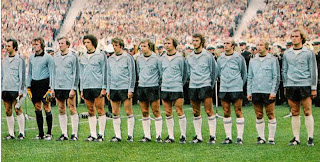
German losers… what else, since second place was actually a major step down for the reigning world champions. From left: Beckenbauer, Maier, Schwarzenbeck, D. Muller, Wimmer, Dietz, Holzenbein, Bonhof, Beer, Vogts, Hoeness.
Brand new European Champions! Top, left to right: Vaclav Jezek – coach, Ladislav Jurkemik, Anton Ondrus, Dusan Galis, Alexander Vencel, Antonin Panenka, Ivo Viktor, Jozef Capkovic, Marian Masny, Pavol Biros, Zdenek Nehoda, Jozef Venglos – assistant coach.
Bottom: Miloslav Kundrat – team’s doctor, Ladislav Petras, Karol Dobias, Jan Pivarnik, Lubomir Knapp, Jan Svehlik, Koloman Gogh, Jaroslav Pollak, Jozef Moder, Vlastimil Ruzicka – masseur.
Oh, well – almost the team: L. Knapp did not make the final selection, but Jozef Barmos, Dusan Herda, Frantisek Vesely, Frantisek Stambachr, and Premysl Bicovsky did. From them only Vesely played at the finals. He was 33 years old at the time – and still enough playing years ahead of him, as it turned out.

Monday, October 31, 2011


Third place still mattered in those days, although for the Yugoslavs it was not exactly something to look forward. From the first minute against Holland it was detectable that Yugoslavia was not firm and determined. The boys in blue attacked, wanted to win, but… there was also something dead in their spirit. Yet, there were no changes in the starting eleven – Yugoslavia was seemingly willing to fight for the third place. But so was Holland, and it was exciting match at the end. Unlike Yugoslavia, the Dutch made changes – Neeskens and van Hanegem were unable to play because of their expulsions against CSSR. Johnny Rep was also absent – he had mediocre match with the Czechs and that seemed the apparent reason. But may be it was not the real reason – players refusing to play were old news about the Dutch. Cruyff was also not on the pitch – the biggest ‘change’, if coach Knobel was permitted to make changes – the mouthy superstar was suspended for two yellow cards. Rene van de Kerkhof and Ruud Geels finally got their chance along with entirely unknown Peters and Arntz. Holland looked more crippled than improved and Yugoslavia once again had the edge in Zagreb.
At least in the first minute. In the 39th minute the result was 2-0 for Holland – the substitutes proved their worth. May be it was time to forget about Cruyff ? May be not… Holland was not so supreme as two years before; with van de Kerkhof twins it was grittier team, lacking finesse and creativity. Holland looked tougher than usual, but Yugoslavia was not waving the white flag and in the absence of Cruyff and Neeskens – the advantage of technical skills and imagination. The regular time ended 2-2.
Holland managed to win in the extra time – Ruud Geels scored his second and this time winning goal in the 107th minute. Once again extra time was the nemesis of the Yugoslavs – unlike their West European opponents, the Yugoslav players did not manage well overtime, neither physically, nor psychologically.
Holland got bronze and perhaps impromptu introduced its own future - Cruyff-less team, with Willy and Rene van de Kerkhof commandeering the game. It was unlikely concocted by George Knobel – he was sacked right away. Indeed, it is very questionable what exactly Knobel did with team Holland – old problems remained without even an attempt for solution. Goalkeeping was a liability – Schrijvers was hardly a good keeper, yet he was first choice. Jan Ruiter, who played splendidly for Anderlecht, was mere reserve – and actually played only once for Holland during his long career. Van Kraay, not exactly newcomer, but hardly a regular before, was rather conservative addition to the defense line, but Rijsbergen and Jansen – Michels’ improvisation in 1974 – were kept precisely where Michels put them. Ruud Geels played well and finally looked like firm starter. Somewhat Holland failed short of the expected.
Zagreb, June 19, Maksimir Stadion
Netherlands 3-2 Yugoslavia [aet]
[Geels 27, 107, W.van de Kerkhof 39; Katalisnki 43, Dzajic 82]
[ref: Hungerbühler (Switzerland); att: 7,000]
Netherlands: Schrijvers, Suurbier, Van Kraay, Krol, Jansen (46 Meutstege), Peters, Arntz (71 Kist), W.van de Kerkhof, R.van de Kerkhof, Geels, Rensenbrink
Yugoslavia: Petrovic, Buljan, Muzinic, Oblak, Katalinski, Zungul (46 Halilhodzic),Jerkovic, Popivoda, Surjak, Acimovic (46 Vladic), Dzajic
Yugoslavia finishing forth. This team was seen as better than the one from 1974 and potential European champion. Plenty of talent, plenty of experience, plenty of motivation. At the end – a disappointment. May be harshly judged by the fans and the media. May be justly so – they failed to win on home turf. This is the line up from the home match against Sweden in the qualifying group, played in Zagreb and confidently won 3-0. Same team lost both final games… true, in extra time, but great teams do not lose. Before the match with Holland Dragan Dzajic announced that the ‘little final’ will be his last appearance for the national team A great player stepped down.
The ‘forgotten’ Holland of 1976. Nobody knew that this will be the last big international tournament for Cruyff. Apart from that, it looks like Dutch practical whimsicality was in good health: remember Cruyff playing with different kit than the rest of the team in 1974? Five more players joined him in 1976 and Holland was really mixed on the pitch. Some with two stripes, others with Adidas’ three.

Standing from left to right: Piet Schrijvers, Ruud Krol, Wim Meutstege, George Knobel, Wim Suurbier, Johan Neeskens, Johan Cruijff, Wim van Hanegem and Jan Ruiter.
Sitting left to right: Adri van Kraay, Wim Rijsbergen, Johnny Rep, Rob Rensenbrink, Willy van de Kerkhof, Jan Peters, René van de Kerkhof and Ruud Geels.
As a whole, a good, strong squad. Perhaps everybody was seeing them as gods, and when gods fail… in fact, it was a winning team: a silver and a bronze so far. What’s wrong with that? Except of deserving better coach.

Saturday, October 29, 2011


The draw for the ½ finals put host Yugoslavia against West Germany, and the Dutch were lucky – facing Czechoslovakia. Predictions? Holland and… it was equally possible to be either the Yugoslavs, or the Germans. The World champions were favoured a bit higher possibility – and replay of the 1974 World Cup final was very likely.
The final tournament opened in Zagreb on June 16, 1975: the first ½ final was between Holland and Czechoslovakia. Both teams came out with their best elevens, Holland practically not different from the squad, who played the final in 1974. Experience, toughness, and above everything – Cruyff, who this year was wearing not the famous number 14, but plain 9. It was the day for CSSR to learn her own place in football, and if nothing bad happened in the first minutes, no worry – it just a matter of time. The Czechoslovakians were somewhat slow to get it… they showed no fear and ignorantly attacked. The punishment came in the 20th minute… but it was punishment for the mighty Dutch – Anton Ondrus, the sweeper, scored: 1-0 for CSSR.
Ondrus scores against Holland.
Holland came back into thegood things ended in the back - midfield and attack were mess, and to this very moment Schon was experimenting without a hint of success. But Germans were Germans and very dangerous just because of that.
Yugoslavia was perhaps the only team in Europe managing painless transition – few aging players from 1974 were out (and playing abroad), but the well of talent was deep – former reserves were now starters; players left behind in 1974 were now donning the blue jersey. Ognjan Petrovic, Danilo Popivoda, Vladic, Peruzovic easily replaced Maric, Petkovic, Pavlovic. There was a brand new hero – Slavisa Zungul. Perhaps the only not crowded position was that of the playmaker – Karasi was gone and there was no new star at home. But there was one playing abroad – Branko Oblak, for Schalke 04 – and this was a player to comnly line without difficulties and having more than enough players to chose from – Kaltz was simply sitting on the bench, for instance. Maier was in superb form – and voted German player of the year for 1975. However, good things ended in the back - midfield and attack were mess, and to this very moment Schon was experimenting without a hint of success. But Germans were Germans and very dangerous just because of that. game in the 77th minute, when Ondrus scored his second goal – unfortunately, in his own net this time. The unthinkable happened in the overtime: CSSR scored 2 more goals, the last by Frantisek Vessely, the substitute veteran, who quite surprisingly was recalled to the national team when everybody thought he was gone forever. Holland scored a total of zero goals – and as the match progressed, it became increasingly clear the Oranje were not the well-oiled machine of two years ago. Three players were sent off, two of them Dutch – frustration governed Holland.
Zagreb, June 16, Maksimir Stadion
Czechoslovakia 3-1 Netherlands [aet]
[Ondrus 20, Nehoda 114, Vesely 119; Ondrus 77og]
[ref: Thomas (Wales); att: 31,000]
[sent off: Pollák 60, Neeskens 76, Van Hanegem 115]
Czechoslovakia: Viktor, Pivarník, Capkovic (106 Jurkemik), Pollak, Gögh, Ondrus, Masny, Panenka, Móder (96 Vesely), Nehoda, Dobiás
Netherlands: Schrijvers, Suurbier, Van Kraay, Rijsbergen (37 Van Hanegem), Krol, Neeskens, Jansen, W.van de Kerkhof, Rep (65 Geels), Cruijff, Rensenbrink.
Next day – the big match in Belgrade! There was not much to say about the Germans – they were disgusting so far, clearly had many troubles, and were not even a shadow of the 1974 team, let alone the one of 1972. They were solid only at the rear: Dietz was the able, if plainer, substitute of departed Breitner, and the rest were very, very familiar. It was the only line without difficulties and having more than enough players to chose from – Kaltz was simply sitting on the bench, for instance. Maier was in superb form – and voted German player of the year for 1975. However, good things ended in the back - midfield and attack were mess, and to this very moment Schon was experimenting without a hint of success. But Germans were Germans and very dangerous just because of that.
Yugoslavia was perhaps the only team in Europe managing painless transition – few aging players from 1974 were out (and playing abroad), but the well of talent was deep – former reserves were now starters; players left behind in 1974 were now donning the blue jersey. Ognjan Petrovic, Danilo Popivoda, Vladic, Peruzovic easily replaced Maric, Petkovic, Pavlovic. There was a brand new hero – Slavisa Zungul. Perhaps the only not crowded position was that of the playmaker – Karasi was gone and there was no new star at home. But there was one playing abroad – Branko Oblak, for Schalke 04 – and this was a player to compensate for any apparent talent in Yugoslavia. He became the first properly foreign based footballer to play for the national team – and to captain it as well. Yugoslavia 1976 was considered much stronger than Yugoslavia 1974, had a splendid qualifying rounds, experience and gift. Motivation was extremely strong, and was playing at home, in front of frantic crowds – Yugoslavia had the edge. On the negative side – as ever, moodiness was recalled as potential weakness. The Yugoslavs were capable of playing fantastic football and beat anybody, but… if were easily given to frustration when the match was not going their way and under pressure the team traditionally was known to quickly collapse.
This time collapse was seemingly not in the cards – by the 33rd minute it was 2-0 for the Plavi. West Germany was practically gone, for the hosts were playing very fast attacking football – too fast for the Germans! There was drama – it was the end of the world champions, who displayed fully their own troubles and limitations. Goners. Finally, a punishment for the lame performance at the (most) of the 1974 World Cup tournament.
The second half started without a sign of improvement – Flohe replaced Danner, which was more a gesture of helplessness… at least at the beginning of the second half. Flohe managed to score in the 65th minute and gradually, almost invisibly, the scales tipped the other way. In the 79th minute Muller came on the pitch, replacing Wimmer – and 3 minutes later he scored the equalizer. Muller is Muller… although it was not Gerd, but brand new Dieter Muller. The old fox Schon seemingly – just like in 1974 – shaped his winning squad in the last minute, yet, exactly when really mattered. The extra time was predictable… it was visible that the Yugoslavs were running out of steam and the Germans getting stronger. Muller scored two more goals – West Germany won 4-2 and found her new Muller in the bargain. Now it was easy to say who will win the championship – for the first time the same country was to be European champion twice and consecutively at that. West German football continued to be the best in the world!
Beograd, June 17, Crvena zvezda
West Germany 4-2 Yugoslavia [aet]
[Flohe 65, D.Müller 82, 115, 199; Popivoda 19, Dzajic 32]
[ref: Delcourt (Belgium); att: 70,000]
West Germany: Maier, Dietz, Schwarzenbeck, Beckenbauer, Vogts, Danner (46 Flohe),Bonhof, Beer, Wimmer (79 D.Müller), Hölzenbein, U.Hoeneß
Yugoslavia: Petrovic, Buljan, Muzinic, Oblak (106 Vladic), Katalinski, Zungul,Jerkovic, Popivoda, Surjak, Acimovic (106 Peruzovic), Dzajic
Too bad for delightful Yugoslavs, but here was the lesson – nobody was able to rise to the occasion as Germans did, and that was the true display of class.
Heartbroken Branko Oblak leaves the pitch, although, playing in West Germany, he should have known who was really best.

Wednesday, October 26, 2011


Before the crown there was the crawl. The European quarterfinals proceeded unspectacularly, in the sense of ending with the expected winners.
Wales, despite of having the ‘best team ever’ – the old staple player Mike England was reduced to a substitute – was no match for Yugoslavia. It was considered the easiest ¼ final draw and it was – Yugoslavia won 2-0 in Belgrade and finished whatever uncertainty survived until the second leg by opening the result in Cardiff in the 18th minute. The match ended 1-1, which hardly mattered anymore – Yugoslavia got the hosting of the finals.
Holland was to meet their archenemy Belgium, traditionally, their toughest opponent. It also looked like eternal couple – the two countries competed in the preliminary group for a 1974 World Cup spot and back then both matches ended in scoreless ties. Not this time: Holland annihilated Belgium in the first leg – 5-0 in Rotterdam. Rensenbrink scored a hat-trick against a squad filled with his Anderlecht teammates. It was over already and in Brussels the Dutch allowed Belgium to score first and after that Rep and Cruyff provided second victory.
West Germany and Spain were seen as the most difficult pair, with odds tipping to the Germans. The opening in Madrid supported predictions: 1-1, which gave the edge to the Germans. In Munich Hoeness and Topmoller scored a goal each in the first half and it was over. By now, Spain was accepted as eternal loser anyway. The Germans continued to struggle, but their willpower was intact and more obviously the key ingredient of German football.
Lastly, Czechoslovakia and USSR. Hardly the toughest draw in purely football terms and of little interest, for by habit whenever the Soviets were playing against another East European team, it was expected the opponent to be ordered to lose. It was not to be that way – Czechoslovakia won 2-0 at home and tying the second leg at Moscow 2-2.
Moder scores the first goals in Bratislava. It was commented in a weird way by the Soviets: a second earlier Pollak was fouled, but since the Czech attack was not interrupted, the Turkish referee Ok did not stop the game. Soviet players, though, were caught by surprise and practically did not react, expecting a free kick. The goal was much commented – as both blunder of the defense and blunder of the referee. The confused reaction was also due to the simple fact CSSR clearly outplayed USSR and there was little reason for complaints.
The second leg in Kiev brought some changes in the Soviet squad and was fought in earnest, but the Czechoslovakians still played better. Here J. Pivarnik clears ahead of V. Veremeev.
I. Viktor wins the air battle with V. Troshkin and clears the ball.
O. Blokhin equalizes and saves the day. Looks ferocious and Viktor, the goalie, entirely helpless – but it was only 2-2 and the Soviet team was out.
In fact, it was the Soviets tying, for the ‘lesser brothers’ lead 1-0 and then 2-1 until Blokhin prevented full-blown disgrace in the 88th minute. Yet, it was a ¼ final worth a comment: there was very little outcry in USSR. It was somewhat strange quarterfinal – before that a friendly was played between the opponents, which was unusual, but very likely arranged way before the UEFA draw was known. The friendly ended 2-2, and although both teams used some deep reserves in it, most players were regulars.
Frantisek Kozinka (playing here for his club Bohemians Prague) appeared in the friendly – the only complete unknown in the Czechoslovakian squad.
Muddy affair – the friendly was played on very tough pitch, but it was not the only mud in the Soviet football.
Some troubles were detected in the Soviet selection and the way they played, and it was considered that Czechoslovakia were particularly difficult opponent. Yet, no visible measures were taken for the real games. It was difficult to figure out what the Soviets were up to – for the first time they had separate Olympic team, coached by its own coach – Konstantin Beskov. The national team was in the hands of Lobanovsky – or more accurately in the hands of the duo Lobanovsky-Bazilevich. Oleg Bazilevich is rarely spoken of today, but at the time it was not Valery Lobanovsky, the great coach – it was Lobanovsky-Bazilevich, equal to each other in both Dinamo Kiev and the national team. They used mostly players from their own club – so many, that even the reserves were from Kiev, and even players, who were substitutes in Dynamo were included – and played – in the national team (Zuev, for instance). This practice came under fire after the day when USSR was represented entirely by Dynamo’s players and slight adjustments were done, but it was mainly Dynamo on the pitch – Zvyagintzev was included in the national team in 1975, as one of the non-Dynamo players, but in 1976 he was no longer captaining Shakter (Donetzk) – he was in Kiev, fighting for a spot in the team with another national player, Reshko. About all that there were complains from Lobanovsky as well – he was unhappy his boys were playing so many matches: national championship and cup; European club tournaments; and in the national team on top of everything. But what was so unfair? It was Lobanovsky using the same 12 players at every possible occasion. And the results vastly differed: Dynamo was the ‘revelation’ in 1975, conquering Europe. The very same team was struggling and shallow with the red USSR shirts – the national team was not winning.
Which immediately brings back the so-called Olympic team. Was it really a separate team? Lobanovsky-Bazilevich took players from it whenever they wanted to do so. However, Beskov had different vision of football, so it was not very clear what was the benefit of taking his players. Besides, Beskov was not shrinking violet and very likely he and Lobanovsky were not at good terms. As a result, neither selection performed well and various players very likely were not happy at all. Typically, nothing appeared in the press – there was suspect silence instead. Small and seemingly casual and unconcerned reports of matches, giving the impression that the Soviets did not really care what was going – this itself was very unusual, for traditionally it was the A-national team which mattered. May be they were counting on the Olympic team? This did not appear true either – Beskov’s team was seemingly of lesser importance: it was players taken from it for the national team, not the other way around (until later, when a bunch of national team players were included for the Olympic Games in Montreal). It is a speculation, but it looked like the Soviets decided the European Champions Cup to be their priority in 1975-76. At least larger and more in depth coverage was done on the progress of Dinamo Kiev in Europe. Whatever was kept in secret, it did not matter in the open – USSR was eliminated after two not particularly great games and Czechoslovakia went to the finals. So far quietly – among the last four teams, CSSR was considered the weakest.

Monday, October 24, 2011


1976

1975 was so bleak, one couldn’t wait 1976 to begin – it was not possible to be worse and future in football is always full of hopes. And the new year materialized them: European Championship, Olympic games, the Intercontinental Coup was played again, new exciting teams emerged. By 1976 total football was no longer something played by few and desired by many – it was the established brand of football. However, it evolved in a unforeseen way: becoming tougher and increasingly lacking imagination. There was embedded contradiction in total football – ideally, it was to be a game in which everyone was capable to play at any position. Curiously, the most creative position – the playmaker (or the dispatcher, or the conductor – different names were used) – suffered from it. Soviet commentators – strangely, for the Soviets were late comers struggling to adapt to total football – proclaimed the end of the playmaker: it was outdated and slowing the game, since traditionally every ball was to go to him in order of developing attack. The new football required whoever had the ball to be able to act as a playmaker of the moment. Sounded good, yet, the observation was made after shallow Soviet performance and in the same article the absence of typical playmaker (Muntyan, in the particular case) was lamented. Was the playmaker obsolete or was he still important? Sure, teams full of stars were able to use them as passers – Holland with Neeskens and van Hanegem; West Germany with Overath, Netzer, Breitner, Hoeness. Yet, it was Cruyff and Beckenbauer who generally ‘made the flow of the game’. Especially Cruyff, who by 1976 was playing far back, hardly on the tip of the attack, but rather in midfield – as a traditional playmaker, in other words. It was hardly automatic – it depended on available players and those lacking skills and vision were able just to run endlessly. Which was becoming the modified brand of total football, endorsed by the West Germans and, increasingly, by the Dutch. Anyway, the year was fun and the crowing moment was the European Championship finals.
It was the 5th continental championship and the last in ‘traditional’ format: qualifying round-robin groups, followed by 2-legged ¼ finals of direct elimination, and 1-leg ½ finals and finals, played in one country. The host of the finals was to qualify, though – no direct participation of the organizers, who were not even organizers yet – it was a host country, decided pretty much after the ¼ finals were played. Yugoslavia hosted the finals – two cities were involved: Belgrade and Zagreb, with the final played in Belgrade at the Crvena zvezda stadium, commonly known as ‘Mala (Small) Maracana’.
It was much more interesting tournament than the one in 1972, although there was no clearly supreme team as West Germany was four years ago. The finals stand unique: not a single match was decided in regular time. The four games run into overtime and penalty shoot-out, which speaks volumes for the level of competition. For the fans, it was great delight – and also big agony, for the drama was huge and tense.
Everything else paled, compared to the European Championship, but still there was plenty of excitement – Saint Etienne and Anderlecht enlarged the number of great playing clubs. And, increasingly, Liverpool was becoming truly great. Italy showed signs of recovery as well. A good year, crowned by the European Championship.