If Dutch football slipped a bit, their Belgian neighbours somewhat improved. The improvement showed itself largely on international level, but when two teams of a single country reach European finals at the same time, it is hardly a freak accident. Like Holland, Belgium was traditionally unimpressive league, dominated by two clubs. Unlike Holland, Belgian football was plagued by financial instability. During the 70s some reforms and tightened rules were tried, the most visible from outside was the enlarged league – a curious move, for other countries in the same financial predicament went the opposite way (Scotland, Austria, and Switzerland reduced their top leagues). Thus, 19 teams played in the 1975-76 season, a weird number, not really making sense. When the dust settled, one thing was immediately obvious: the sharp decline of Standard (Liege) – they finished 8th. Signs of reshaping were detected in the first half of the 70s, but probably this season finally made permanent the new duopoly – no longer Anderelecht – Standard rivalry, but Anderlecht – FC Bruges. With time, Standard somewhat restored its leading position, but only as the third strongest Belgian club. On the other hand, FC Bruges was perhaps taken seriously at last as legitimate contender. They won the championship confidently, with comfortable 4-point difference. Anderlecht finished 2nd, but the champions outscored them by 16 goals: FC Bruges scored 81 goals to Anderlecht’s 65. Of course, the joy in the Bruges camp was huge – it was their 3rd title so far – but there was more to it. If their winning in 1973 was shrugged off as more or less one time wonder (what else could be since there were 53 years between first and second title), the 1976 victory showed consistency: FC Bruges arrived and were to stay on top.

Or may be not… their photo is fun and the kit is cool, but how serious can be a team looking like that? Sponsored by denim jeans manufacturer? Goofy, somehow… Or may be not so goofy… Standing, from left: Mathieu Bollen (assistant-coach), Birger Jensen, Daniel De Cubber, Georges Leekens, René Vandereycken, Eddie Krieger, Ulrik Le Fèvre , Hugo Pieters.
Sitting: Jos Volders, Fons Bastijns, Roger Van Gool, Norbert De Naeghel, Ernst Happel (coach), Julien Cools, Raoul Lambert, Konrad Holenstein, Dirk Sanders.
Ernst Happel, the Austrian coach, who led Feyenoord to the European Champions Cup in 1970, was at the helm. His reputation was not just solid, but still rising – the success with FC Bruges just moved Happel higher, and soon he will be among the few best coaches in the world. His team was impressive as well, although not based on terribly expensive stars. The best known player was Raoul Lambert, one of the top Belgian players at the time. The three foreign players were lesser known: the young Austrian full back Eddie Krieger and two Danes – the goalkeeper Birger Jensen and the winger Ulrik Le Fevre. Like Krieger, Jensen was very young; but unlike the Austrian, he was not a national player of his home country. Le Fevre was solid and well known professional, who came from Borussia (Moenchengladbach). International star he was not and by now he was already fading, but his vast experience was helpful. The rest of the team was not really known outside Belgium, but not for long: some reputations soared precisely this season – Georges Leekens, Rene Vandereycken, Fons Bastijns, Roger van Gool. FC Bruges was no joke.
The season was good for another, smaller, Belgian club as well: KSC Lokeren.
The ‘Tricolores’ had checkered history, more troubles than success, and their latest move fitted the tradition: in 1975 they acquired Wlodzimierz Lubanski. The biggest Polish star surely, but what a risk – the whole transfer was based on his heavy injury, preventing him from playing at the 1974 World Cup. In Poland Lubanski was considered uncurable… which was the whole reason for allowing him to play abroad. Looked like Lokeren got nothing… but the striker recovered and with his help Lokeren had one of their best seasons. They finished 4th, thanks to the ‘goner’. The ‘goofy’ deal suddenly turned out to be a golden egg. Standing, from left: Hogenboom, Verschuren, Somers, Evevaert, Suykerbuyk, Vekkeneers, Novak – coach, Van Lessen, Lubanski, Verheyen, Dalving, De Paepe.
Sitting: Hansen, Ingels, Puis, Derycker – president, Devrindt, De Koning, De Schrijver.
Well, Mr. Derycker has every right to be so big with a lucky strike like Lubanski’s transfer… Apart from the Polish star KSC Lokeren was not much: only Johan Devrindt was quality player – well established national player, who played at 1970 World Cup and the 1972 European Championship final round. However, he was aging. Eventually two other players acquired some fame as Belgian national players – Maurice De Schrijver and especially Rene Verheyen – but it was much later, in the 1980s. Sure, there were two more foreigners, but small caliber – the Danish striker Halfdan Hansen and the Dutch defender Jan De Koning. Derycker was getting fat from Wlodzimierz Lubanski and Johan Devrindt. Mostly from Lubanski, really – one man made a huge difference. It was clear that Lubanski was a player for bigger and better club, and may be the player was very unlucky. Who knows? Communist officials rarely made good transfers and the wellbeing of the players they sold was never a concern for them. But Lubanski was considered finished and just lucky to get professional contract. He was not really expected able to play again… Anyhow, Lubanski deserves admiration for his loyalty: his recovery propelled him among the stars once again and surely he had better options after the 1975-76 season – but he stayed with Lokeren, where it was painfully clear that nothing really big will happen.
Or may be not… their photo is fun and the kit is cool, but how serious can be a team looking like that? Sponsored by denim jeans manufacturer? Goofy, somehow…
Or may be not so goofy… Standing, from left: Mathieu Bollen (assistant-coach), Birger Jensen, Daniel De Cubber, Georges Leekens, René Vandereycken, Eddie Krieger, Ulrik Le Fèvre , Hugo Pieters.Sitting: Jos Volders, Fons Bastijns, Roger Van Gool, Norbert De Naeghel, Ernst Happel (coach), Julien Cools, Raoul Lambert, Konrad Holenstein, Dirk Sanders.
Ernst Happel, the Austrian coach, who led Feyenoord to the European Champions Cup in 1970, was at the helm. His reputation was not just solid, but still rising – the success with FC Bruges just moved Happel higher, and soon he will be among the few best coaches in the world. His team was impressive as well, although not based on terribly expensive stars. The best known player was Raoul Lambert, one of the top Belgian players at the time. The three foreign players were lesser known: the young Austrian full back Eddie Krieger and two Danes – the goalkeeper Birger Jensen and the winger Ulrik Le Fevre. Like Krieger, Jensen was very young; but unlike the Austrian, he was not a national player of his home country. Le Fevre was solid and well known professional, who came from Borussia (Moenchengladbach). International star he was not and by now he was already fading, but his vast experience was helpful. The rest of the team was not really known outside Belgium, but not for long: some reputations soared precisely this season – Georges Leekens, Rene Vandereycken, Fons Bastijns, Roger van Gool. FC Bruges was no joke.
The season was good for another, smaller, Belgian club as well: KSC Lokeren.
The ‘Tricolores’ had checkered history, more troubles than success, and their latest move fitted the tradition: in 1975 they acquired Wlodzimierz Lubanski. The biggest Polish star surely, but what a risk – the whole transfer was based on his heavy injury, preventing him from playing at the 1974 World Cup. In Poland Lubanski was considered uncurable… which was the whole reason for allowing him to play abroad. Looked like Lokeren got nothing… but the striker recovered and with his help Lokeren had one of their best seasons. They finished 4th, thanks to the ‘goner’. The ‘goofy’ deal suddenly turned out to be a golden egg.
Standing, from left: Hogenboom, Verschuren, Somers, Evevaert, Suykerbuyk, Vekkeneers, Novak – coach, Van Lessen, Lubanski, Verheyen, Dalving, De Paepe.Sitting: Hansen, Ingels, Puis, Derycker – president, Devrindt, De Koning, De Schrijver.
Well, Mr. Derycker has every right to be so big with a lucky strike like Lubanski’s transfer… Apart from the Polish star KSC Lokeren was not much: only Johan Devrindt was quality player – well established national player, who played at 1970 World Cup and the 1972 European Championship final round. However, he was aging. Eventually two other players acquired some fame as Belgian national players – Maurice De Schrijver and especially Rene Verheyen – but it was much later, in the 1980s. Sure, there were two more foreigners, but small caliber – the Danish striker Halfdan Hansen and the Dutch defender Jan De Koning. Derycker was getting fat from Wlodzimierz Lubanski and Johan Devrindt. Mostly from Lubanski, really – one man made a huge difference. It was clear that Lubanski was a player for bigger and better club, and may be the player was very unlucky. Who knows? Communist officials rarely made good transfers and the wellbeing of the players they sold was never a concern for them. But Lubanski was considered finished and just lucky to get professional contract. He was not really expected able to play again… Anyhow, Lubanski deserves admiration for his loyalty: his recovery propelled him among the stars once again and surely he had better options after the 1975-76 season – but he stayed with Lokeren, where it was painfully clear that nothing really big will happen.


 As for the squad, it was practically the same as the year before (which hardly helps with the names – there are number of misspelled names above. British photo of the same time simply misspells different names. Above, the third from left, first row is not ‘Rraay’, but Adrie van Kraaij. Or van Kraay? Hmmm) Only Bjorn Nordqvist was no longer in the team – the 33-years old veteran returned to Sweden and IFK Goteborg. The new foreign recruit was typically Dutch deal: Nicholas Deacy was acquired from Hereford United. Ever heard of him? No matter – he was young (born 1953) and inexpensive. Yes, he played for the national team of Wales, but that’s about everything. However, the deal worked for both club and player, so no harm done. Other newcomers were defenders – Jan Poortvliet and Huub Stevens. Both eventually played for Holland, but perhaps are better known as coaches, Stevens in particular. As a whole, the Dutch champions were just at the right age – the team was mostly 25 or younger , yet already vastly experienced. The core consisted of national players, however, almost all played second fiddle in the Oranje selections. The exception were the van de Kerkhof twins – they were increasingly becoming key players in the Dutch national team, and surely pulled the strings in PSV.
 The life of twins: raising together, falling together – Rene and Willy (right) van de Kerkhof carried out of the pitch, injured in match against FC Amsterdam – Rene in the 8th minute of the first half, and Willy in the 8th minute of the second. May be their sameness was what prevented PSV Eindhoven of becoming a great team.
 Sitting, from left: Bento, Moinhos, Jordao, Nelinho, Diamantino.
 By now, a rare success for Os Belenenses. This is line up from 1976-77 season, but essentially the squad was the same in 1975-76: top, left to right: Quaresma, Sambinha, Melo, Joao Cardoso, Isidro.
 Boavista and Vitoria coming out to compete for the Portuguese Cup.
 For Boavista, the best years of their history (so far) started – the team remained strong, at least in Portugal, to the early 1980s. Very bearded squad, but darlings really – Boavista played (from what I have seen) mellow, technical football. Nothing great, but enjoyable to watch. Having a soft spot for the underdog, I was happy for them and still like them. But in more realistsic terms, Boavista was hardly the bright future of Portuguese football – revival did not come in the 70s. Not only the new stars were not on the level of those from the 60s, but they often went to play abroad – mostly lured by Spanish clubs. It was difficult to compensate the drain of talent – Portuguese clubs rarely had money for big foreign stars. It was difficult to keep them too – the Argentine goal-scoring machine Hector Yazalde already moved to Olympique (Marseille). The only big foreign name by 1976 was the Peruvian great Tefilo Cubillas.
 Cubillas in attack for FC Porto.
 Almost good… the losing Cup finalists: first row, left to right: Bonic (?), Janjanin, Kranjcar, Vabec, Senzen.

 Another strong season for Hajduk and the best Yugoslavian squad as well. Unlike Crvena zvezda, no crisis occurred when stars went abroad or retired – Muzinic, Dzoni, Jerkovic, Buljan, Peruzovic, Surjak were still young and the the backbone of the national team already. Zungul was making a name for himself fast as well – and played for the national team. And Boljat and Katalinic were pushing ahead too. The future was bright. The present was to be envied – a model club. No wonder the boys from Split were not tempted to go to Zagreb and Belgrade.
 It was not a confident win by any means – Partizan clinched first place one point better than second-placed Hajduk. May be outside factors made the victory possible – Hajduk and Crvena zvezda had too many players in the national team and preoccupation with the European Championship weakened them on the home front. Crvena zvezda was also going through change of generations – old players were steadily going abroad after 1974 and new team was not ready yet (they finished 4th). May be Partizan won by an accident, but the ‘gravediggers’ used the opportunity, fought for the title and grabbed it. Their 7th title – by numbers alone, the Army club was still the main rival of Crvena zvezda.
 Champions at last: standing from left: Kozic, Tomic, Arsenovic, Djordjevic, Djurovic, Ivancevic.
 Top, from left: Ognjen Petrovic, Jelikic, Krivokuca, Keri, Muslin, Baralic.
 Banik (Ostrava) – Dukla (Prague). Nehoda (Dukla) scores in the net of Michalik (Banik). At the end of the season Michalik was champion of CSSR, but Nehoda champion of Europe. They were to play side by side for the national team soon.

 Oil and arms go together… well, not always. Inter (in stripes) had no respect for the rifle-makers - Zbrojovka. The unfortunate goalkeeper Hron can only watch Pospisil (#10) scoring and the match ended at that – 1-0 for Inter (Bratislava).
 And the match no gun ever win… against the referee. Sarganek dismises Zbrojovka (Brno) players Kroupa nd Vaclavicek. Kind of bored, isn’t he?
 More riflemen, this time in attack: Zbrojovka (dark shirts) vs SKLO Union (Teplice).
 Tough life for a goalkeeper… but who is attacking and who is defending? Well, Dukla (Prague) tries to score in the net of Inter (Bratislava). Slovaks were increasingly under Czech siege this season.
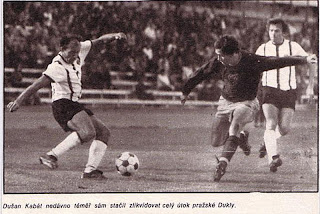 It was not an easy victory of the Czechs at all – Slovaks still had enough teeth left. Dusan Kabat (Spartak Trnava) makes a full of Dukla (Prague) defender. Alas, the great team of Trnava was already declining.
 Not much love between Czechs either: Barat (Bohemians Prague, in stripes) strikes a bit before Huml (Banik Ostrava) tackled him. Bohemians were playing better and better, but it was the year of Ostrava, so it was Huml victorious at the end of season.
 More of the Czech – Slovak battles? Slavia (Prague) had a strong season and here their stopper Frydrich almost scores in the net of Inter (Bratislava, in stripes).


