Sunday, August 4, 2024

Portugal I Division

First Division. The planned increase of the Portuguese top league benefited one team this season – because only 2 teams were relegated, 18th place was safe spot for the moment. As for greater benefits... what benefits? Two teams dominated the championship. Bellow the leaders two other teams were way stronger than the rest of the league, yet, way weaker than the leaders. This configuration was traditional , no matter how many teams played in First Division. More teams hardly ever translate into more competitive championships.

Feirense – last with 20 points and relegated. Pretty much as expected.

Portimonense - 17th with 21 points. Their 3 Bulgarians did not save the club from relegation.

Uniao Madeira survived - 16th with 24 points.

Penafiel - 15th with 26 points.

Nacional - 14th with 28 points.

Estrela Amadora - 13th with 28 points. Nothing much in the league, as usual, but this was also their greatest season.

Sporting Braga - 12th with 28 points.

Beira Mar - 11th with 29 points.

Maritimo - 10th with 29 points.

Tirsense - 9th with 30 points. Strong season for them, even surprisingly strong.

Boavista - 8th with 34 points.

Vitoria Setubal - 7th with 36 points.

Belenenses - 6th with 36 points.

Chaves - 5th with 38 points. Strong season for them, yet, unable to challenge the strongest.

Vitoria Guimaraes - 4th with 45 points. Not concerned with the bulk of the league, but fighting only for bronze medals, eventually losing the battle.

Sporting Lisbon clinched 3rd place with 46 points. More than that was not up to them.

And finally the two leaders – the usual suspects Benfica and FC Porto. The rest of the league was only point-providers, the top teams were way above the rest.

Benfica lost only 2 games and scored most goals this season – 76 – but they lost the battle, finishing with 55 points. 9 points ahead of their city rivals Sporting, but not the real enemy was from another city and Benfica was unable to beat it.

FC Porto was really flying this season: 27 wins, 5 ties, only 2 lost games, 72-16 scoring record and 59 points at the end – 4 more than Benfica, the rest of the league did not even count. Already famous coach, wonderful squad, more perspective than Benfica's – FC Porto established itself not just as leading Portuguese clubs, but as one of the top European clubs.

Not a squad to be taken lightly, combining talent with experience, combining worthy veterans with bright young talent. Not only they left Benfica behind, but looked like Benfica will stay behind FC Porto in the 1990s. As for the record, they won their 11th title.

Friday, August 2, 2024

Portugal II Division


Portugal. Ranked 6th. Changes were coming: next season First Division was increasing to 20 teams and instead of 3 zones of 18 teams, Second Division was going to be single league of 20 teams. Because of that, final positions had special significance, especially in the Second Division: 2 teams were relegated from top flight. 4 teams were promoted from Second Division – the winners of the Zones plus one the second-placed teams, perhaps a winner of play-offs. The make of the new Second Division was more complicated: no promotion from third level, first of all. 2 teams relegated from First Division. Then those who finished 2nd – to 7th place in every zone. However, one of the second-placed teams was going to top flight, so to make a 20-teams league a final play-off between the 8th placed teams in the zones decided the last spot in the new league. For a club to remain a second-tier team it was a must to finish no lower than 8th place this season – it was no joke: the Second Division was going to be reduced from 54 teams to 20. What follows here is a glance at the current Second Division, including the top-positioned teams going to the new reduced 1990-91 league.

Zona Norte.


Among the unfortunates going to play third level football next season Rio Ave FC was perhaps the best known – they were 10
th with 31 points and out.


Leixoes SC - 8th with 35 points and going to promotion/relegation playoffs.


Varzim SC - 7
th with 38 points.

SC Freamunde - 6th with 40 points.

FC Maia - 5th with 41 points.

FC Pacos de Ferreira - 4th with 42 points.

CD Aves - 3rd with 45 points.

FC Famalicao - 2nd with 47 points and going to promotion playoffs.

Gil Vicente FC – winner with 49 points from 22 wins, 5 ties, 7 losses, 51-25 goal-difference, and happily promoted to First Division.

Zona Centro

Arguably, SC Covilha was the best known among the teams going to third level – they finished 10th with 33 points.

Uniao Mirense was 8th with 35 points and going to promotion/relegation playoffs.

Benfica Castelo Branco was lucky - 7th with 35 points, besting Uniao Mirense on head-to-head record.

RD Agueda - 6th with 38 points.

Academico Viseu - 5th with 42 points.

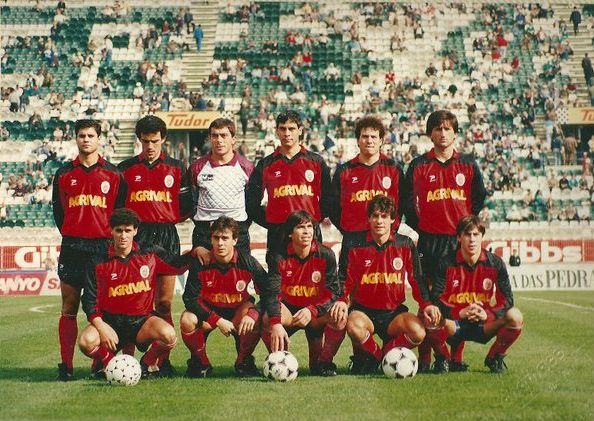
Academica Coimbra - 4th with 43 points. Standing from left: Vítor Nóvoa, Fernando Couto, Coelho, Real, Mito e Reinaldo. À frente: China, Mota, Tomás, Tózé e Meireles.

UD Leiria - 3rd with 49 points.

SC Espinho - 2nd with 50 points and going to promotion playoffs.

SC Salguieros – champion with 51 points and promoted to top flight. 22 wins, 7 ties, 5 losses, 82-24 goal-difference.

Zona Sul

Silves FC - 11th with 32 points – was one of the unfortunate teams going to third level.

Juventude Evora - 8th with 36 points and going to promotion/relegation playoffs.

Lusitano VRSA - 7th with 41 points.

GD Estoril Praia - 6th with 42 points.

SCU Torreense - 5th with 43 points.

O Elvas CAD - 4th with 44 points.

Louletano DC - 3rd with 46 points.


FC Barreirense - 2nd with 47 points and going to promotion playoffs.

SC Farense – winner with 55 points from 25 wins, 5 ties, 4 losses, 80-23 goal-difference. Promoted back to First Division. There was more, though.

The playoffs followed the regular season.

First, the play-offs for the last spot in the new Second Division – between the 3 teams at 8th position in the zones – Juventude Evora, Uniao Mirense, and Leixoes SC. Leixoes won the games against their rivals, finished first and remained in the Second Division. The other two joined the big group clubs going to third level.

There is no available record, but the only reason for the 4th promoted to top team this year would have been playoffs between the second-best teams in the zones. FC Barreirense, SC Espinho, and FC Famalicao.


FC Famalicao was the promoted team – and good for them.

Lastly, there was the mini-tournament between the winners of the zones for the Second Division title: Farense finished last in it with 3 points, Gil Vicente - 2nd with 4 points, and Salgueiros won the title with 5 points: 2 wins, 1 tie, 1 loss, 6-3. They were the new champions of Second Division, which was mostly for pride – all zone winners were promoted to top flight already and that was more important achievement.

And that was all, in brief. Salgueiros, Gil Vicente, Farense, and Famalicao were promoted to the increased First Division – none was newcomer to top flight.

Tuesday, July 30, 2024

Belgium the Cup


The Cup final opposed surprise finalists – given the strength of the 3 top teams in the league, it was interesting that none of them reached the final. Instead two neighbours near the bottom of the table met at the final: RFC Liege (12th) and Germinal Ekeren (13th). The upper team prevailed 2-1 and got the Cup.


Germinal Ekeren lost. Perhaps the tiny difference between them and RFC Liege was at play and it was only fair ending: Germinal ended 1 point behind RFC Liege in the championship and lost by 1 goal the Cup final. Small difference, but still a difference.


RFC Liege won the Cup and this season suddenly became their best ever: although not memorable in the championship, they had a good UEFA Cup run, combined with winning the Belgian Cup – their first and only trophy. Perhaps against one of the leading Belgian clubs RFC Liege had no chance, but they were lucky to met similar to themselves team and prevailed. The winners were modest team – their only well known player was the former Anderlecht and Belgian national team goalkeeper Jacky Munaron, now 34 years old. The midfielder Danny Boffin (25 years) was the only player called to the current national team of Belgium (and because of that very likely to be snatched by one of the big clubs in short time). The foreign talent was not first either – an Yugoslav duo Zvonko Varga and Nebojsa Malbasa, both 31 years old, who were second-rate (if not third-rate) players back at home. Not bad, but not great either. Perhaps the key for RFC Liege's success was their coach – Robert Waseige, a well-known name for years, vastly experienced and with well deserved reputation. Getting old for sure – already 61 years old – but still better coach than the one at the helm of Germinal Ekeren. He extracted more from the modest squad at his hands than expected and the Cup formats were suitable for that 'more'. Thus Belgium had new name added to the list of Cup winners and RFC Liege finally got a trophy. What a sweet victory it was: modest RFC Liege got a trophy when both mighty Anderlecht and their own big rival at home, Standard, finished this season with empty hands.

Sunday, July 28, 2024

Belgium I Division


First Division. Three teams way above the rest, yet, not real drama between them. As usual, Belgian clubs were full of imported players – some names will be given as an illustration.


Racing – or KRC Mechelen – last and relegated with 21 points. The city of Mechelen was unable to keep 2 clubs in the top league. The former Dutch national team player Benny Wijnstekers, 35 years old, was the big name in the squad.


KSK Beveren - 17th with 24 points and relegated. Hard to imagine this club won 2 titles not long ago. Apart from the brother of the famous Jean-Marie Pfaff – Danny Pfaff, two other players catch the eye: the 36-years old Marek Kusto, from the great 1974 World Cup Polish national team, and the Dutch striker Peter van Vossen, still 22 years old and unknown, but who will become significant star later.


KSV Waregem – barely escaped relegation: 16th with 25 points. Hardly any well known players in the squad: the former Ajax (Amsterdam) goalkeeper Hans Galje (33 years old) and well-traveled Irish defended Jack McDonagh (28 years old).

St-Truiden – or K. Sint-Truidense VV - 15th with 27 points. Occasional Yugoslavia national team player Ivan Cvjetkovic (30 years old) was the best known name in the squad. Jacques Kingambo (28 years old) was one of the many players from Zaire playing football in Belgium through the years: familiar from elsewhere relation with former colony.


Sporting – or R. Charleroi SC - 14th with 27 points. A cluster of well-known veterans here: former Belgian national team players Raymond Mommens (32 yearls old) and Leo Van Der Elst (28 years old), plus Romanian former international Rodion Camataru (32 years old), the Chilean national team player Osvaldo Hurtado (31 years old), British defender Kevin Pugh (30 years old), and Zairian Christian Vavadio (25 years old).


Germinal Ekeren - 13th with 27 points, yet, they almost had their best season in history up to 1990. Former Czechoslovak national team player Werner Licka (36 years old) was perhaps the best known name in the squad, but Dutch defender Ernie Brandts (34 years old) had silver medal from the 1978 World Cup. The rest of the Dutch presence was different: Ronny Prins (35 years old) was best known as the son of Dutch legend Co Prins and 22-years old Henk Vos was yet unknown.


RFC Liege – or Club Liegeois - 12th with 28 points. They had their best season ever, though. Good coach and dependable core of players.


KSK Lokeren Oost-Vlaanderen - 11th with 28 points. Had stronger seasons and famous players in the past, but generally a modest club, so its current stars: Marko Myyry (23 years old) from Finland, Hungarian national team players Ferenc Meszaros (27 years old), and 2 Nigerians – John Esin (21 years old) and Siasia Samson (23 years old). Belgian clubs looked for African players for years and now paid close attention to rising Nigerian talent – and were right.

Lierse SK - 10th with 28 points. Their coach was the best known name... however, Barry Hulshof of the great years of Ajax (Amsterdam) as a coach never reached the class of player Hulshof. Another Dutch in the team – Eric Viscaal (22 years old) – will become eventually well-known.

Cercle Brugge KSV - 9th with 31 points. They were never able to really compete with big and famous city rivals, keeping modest profile. Three Yugoslavs this season – Jerko Tipuric (30 years old), Branko Karacic (30 years old), and Josip Weber (26 years old). Not first-rate Yugoslavs and practically unknown, however, Weber eventually not only took Belgian citizenship, but played successfully for the Belgian national team.

Beerschot – or K. Beerschot VAC - 8th with 32 points. Rather familiar performance – mid-table. Great, but aging coach – Georges Heylens – who did what he could with a squad based on few foreigners: well-remembered Dutch striker Simon Tahamata (34 years old), two long-time Romanian national team players – Lucian Balan (31 years old) and Gino Iorgulescu (31 years old), and Hungarian national team player Laszlo Szabadi (29 years old). Add the 36-years old veteran Jos Daerden, who had some national team appearances in the past.

KV Kortrijk - 7th with 33 points. Given their modest history, this was very strong season for Kortrijk. The usual Belgian 'secret' was at play – a core of oldish, vastly experienced players: Gerard Plessers (31 years), Michel De Wolf (32 years), Filip Desmet (32 years), the Yugoslav Desnica, the 34-years old (West) German captain Dieter Schwabe, and the Bulgarian prolific goal-scorer Petar Alexandrov (28 years old), who was also regular national team player for years, including in the 1994 World Cup squad, but given the competition he had, never becoming very well known outside Bulgaria.

KAA Gent - 6th with 36 points. Coached by former Belgian star Rene Vandereycken, but the usually made team: a core of experienced veterans run the show. A good coach and well-blended veterans was the key to (relative) success. Of the Belgians former national team midfielder Danny Veyt (34 years old) and Michel De Groote (35 years) were the best known. They were helped by Israel's national team striker Near Levin (28 years) and former Poland's national team goalkeeper Jacek Kazimierski (31 years), who was a bit obscure, but still played 32 games for Poland. Young talent was African – the Zairian Henri Balenga (24 years old).

Standard Liege - 5th with 42 points. Missed qualifying for the UEFA Cup by a point, but actually it was very weak season. Well-known and respected coach – (West) German Georg Kessler – and a group of strong players of higher status than the players most Belgian clubs had: Belgian national team players Gilbert Bodart (28 years) and Guy Vandersmissen (33 years), the Yugoslav 'super-pro' Ljubomir Radanovic (30 years), two national team players for Israel – Shalom Tikva (25 years) and former Liverpool striker Ronny Rosenthal (27 years), one of the greatest Mexican stars in the 1980s and 1990s Carlos Hermosillo (27 years). But that was all and what worked well for smaller clubs was not well for a leading club like Standard – to have a cluster of strong players did not translate into great team running for the title, but rather disjointed team with too many gaps. Of course, Standard was classier than most and there was no way to slip down the table ,but it was still a weak and disappointing season.

Royal Antwerp FC – or Antwerpen - 4th with 43 points. Strong season and perhaps a good example for achieving more with less. That is, a few strong players expired relatively pedestrian teammates to solid performance, led by not famous, but dependable coach – the Yugoslav Dimitri Davidovic. The core was small: Belgian national team star Nico Claesen (28 years old) was the top player for sure – he already played in England and West Germany. Alex Czerniatinski (30 years) was no longer national team player and fading, but still a great leader for lesser club like Antwerp. The Yugoslav Ratko Svilar was written off the Yugoslav national team, but the old goalkeeper was practically an icon for Antwerp already, seemingly not aging at all and maintaining constant good form. To the stars two more experienced foreigners could be added – the (West) German Hans-Peter Lehnhoff and the Dutch Frans van Rooy. The rest of the team was even less known than Lehnhoff and van Rooy, but sturdy enough.

Top row from left: Johnson (?) - masseur, Ronny Van Rethy, Wim Kiekens, Rudy Smidts, Nicky Schippers, Ralf Geilenkirchen, Hans-Peter Lehnhoff, Frank Mariman, Van Ranst (?) - masseur. Middle row: Jansen (?) - doctor, Nico Broeckaert, Franky Dekenne, Mejer (?),Ronny Van Geneugden, Geert Hoebrechts, Alex Czerniatinski, Yves Vanderveeren, Geert Emmerechts, Henckens (?) - organizer. Sitting: Vandamme (?) - assistant coach, Ratko Svilar, Rudy Taeymans, Wim Kiekens , Frans van Rooy, Dimitri Davidovic – coach, Raphael Quaranta, Nico Claesen, Patrick Schrooten, Wim Deconinck, Koelkelkoren (?) - assistant coach.

KV Mechelen - 3rd with 50 points. Keeping strong – 7 points ahead of Royal Antwerp, lost only 3 games this season (2nd best record) and allowing just 14 goals in their own net (the best record this season) – but not able to compete for more than second place and that they lost by 3 points. For a small club KV Mechelen was doing great – namely, they managed to stay strong, somehow managing to replace one good coach with another (Aad de Mos was replaced by fellow Dutchman Ruud Krol), to keep most of their strong players and even add worthy additions.

Top row from left: Ludwig De Clercq – conditional coach, Bruno Versavel, Patrick Versavel, Philippe Albert, Graeme Rutjes, De Greef, John Bosman, Wout Verhoeven – kinesist.

Middle row: Walter Jaspers – doctor, Fi Van Hoof – assistant coach, Koen Sanders, Erwin Koeman, Marc Wilmots, Wim Hofkens, Leo Clijsters, Ruud Krol – coach, Jan De Cleyn – masseur.

Sitting: Geert Deferm, Paul De Masmaeker, Pascal De Wilde, Wilfried Dommicent, Michel Preud'homme, Frederic Halleux, Marc Emmers, Frank Leen, Francis Severeyns.

Ruud Krol inherited strong and very much together squad, so he did not have to make big changes. By now the starters had solid success and reputation: Erwin Koeman was European champion with Holland, Michel Preud'homme was becoming number one choice of the Belgian national team (Jean-Marie Pfaff getting old and nearing the end of his career), Bruno Versavel, De Masmaeker, and Clijsters were getting included in the Belgian national team, John Bosman was still eyed by Dutch national team coaches. The other regulars were European Cup Winners Cup winners, some had even more success on club level (Bosman won European trophy with Ajax, Preud'homme had successful seasons both in Belgium and Europe with Standard Liege). The squad remained generally a combination of Belgian and Dutch players, which was fine mix in terms of language and culture. KV Mechelen remained among the top Belgian teams and looked like they will stay strong in the future as well.

RSC Anderlecht - 2nd with 53 points. By itself, nothing strange Anderlecht ended at 2nd place. Yet, looking at the squad and comparing it to any other in the Belgian league it... Anderlecht had one of the hottest coaches in Europe – the Dutch Aad de Mos (helped by one of the great 1970s team – Dockx). It had much superior squad than any other team, full of Belgian and other stars, there were pretty equal players competing for each post. Grun, De Wilde, Degryse, Vervoort, Vanderlinden, rapidly rising Luc Nilis plus a record number of foreigners – perhaps no team in Belgium or elsewhere had 13 foreign players before: the 1988 European champion with Holland van Tiggelen plus compatriot Kooiman, two fairly well known Yugoslavs Jankovic (coming to Anderlecht after 4 years with Real Madrid) and Stojic, Swedish new star Zetterberg, Gudjohnsen (Iceland), Keshi (Nigeria), Musonda (Zambia), Osondu (Nigeria), Andersen (Denmark), Ukkonen (Finland), Samba N'Diaye (Senegal), and Robbie Slater (Australia). Winning the title appeared to be sure thing, yet Anderlecht won exactly nothing, finishing 4 points behind the champions and not reaching even the Cup final. So much talent, but something did not click...

Sitting from left: Filip De Wilde, Guy Marchoul, Marc Degryse, Marc Van der Linden, Marc Wuyts, Philip Osondu, Ranko Stojic.

Middle row: Aad de Mos -coach, Benny Debusschere, Luis Oliveira, Bertrand Crasson, Arnor Gudjohnsen, Charly Musonda, Gert Verheyen, Luc Nilis, Par Zetterberg, Patrick Vervoort, Jean Dockx – assistant coach.

Top row: Henrik Andersen, Georges Grun, Milan Jankovic, Stephen Keshi, Adrie van Tiggelen, Donald Van Durme, Wim Kooiman, Kari Ukkonen.


FC Brugge – or Club Brugge KV – won the title with 57 points – 4 points ahead of Anderlecht, 7 points ahead of KV Mechelen, and 14 points ahead of 4th placed Royal Antwerp. 25 wins, 7 ties, and only 2 lost games, 76-19 goal-difference. Tied with Anderlecht as best scorers in the championship and having second-best defensive record, behind KV Mechelen (permitting only 14 goals in their net).

Top row from left: Cedomir Janevski, Tew Mamadou, Lorenzo Staelens, Jan Ceulemans, Luc Beyens, Foeke Booy, Franky Van der Elst.
Middle row: Eddy Warrinnier (kine), Luc Somers, Frank Farina, Peter Creve, Pascal Plovie, Alex Querter, Serge Kimoni, Ronny Desmedt (assistant-coach).
Front row: Philippe Vande Walle, Vital Borkelmans, Stefan Vereycken, Georges Leekens (coach), Hans Christiaens, Yves Audoor, Dany Verlinden.

Strong squad, yes, but compared to Anderlecht, it looked inferior in everything – good coach, Leekens, but not famous as Aad de Mos. The top Belgian players here – Ceulemans and Van der Elst were aging and yesterday's news, compared to the top Belgians of Anderlecht. The foreigners were not only fewer, but significantly of lower class than Anderlecht's foreign legion: Laszlo Disztl (Hungary, 28 years old), Cedomir Janevski (Yugoslavia, 29), Frank Farina (Australia, 26), Foeke Booy (Holland, 28), and Tew Mamadou. Unlikely as it was, this squad had no rival and played very strong season. Thus, FC Brugge won its 8th title.