Wednesday, April 15, 2009

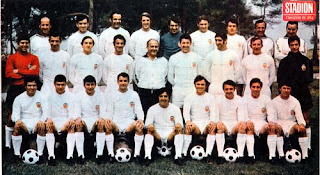
Vultures refuse to die, but swans refuse to come to life sometime. Leeds United was to be the new big thing. A superclub on the level of the supreme Real Madrid of 1956-62. Well, well… they did not win the English title. Nor the other up and coming club – Liverpool. Nor Manchester United, still having its glorious squad of 1968. It was Arsenal in 1971 – both champions and cup winners. English competitive tradition was still alive and well. For some mysterious reason I never like Arsenal, but here they are:
Back row left to right: George Wright (physiotherapist), Bob McNab, Peter Storey, Peter Simpson, Geoff Barnett, Bob Wilson, John Roberts, Ray Kennedy, Peter Marinello, Don Howe (coach)Front row: Charlie George, John Radford, George Armstrong, Jon Sammels, FrankMcLintock, Bertie Mee (manager), Pat Rice, Eddie Kelly, George Graham, Sammy Nelson.
F. A. Cup winners: McNab, Armstrong, Kennedy, Kelly, Storey, Wilson, George, McLintock, Graham, Rice, Simpson.Exciting Arsenal were not, tough and dull – yes. Still are… Solid players, yet without real stars. Some big promise – fulfilled in the case of Ray Kennedy, but with Liverpool; unfulfilled in the case of Charlie George. Great manager – Bertie Mee, yet pretty much at the end of his career; not so great coach – Don Howe, who will build better reputation. On the wings of their success, Arsenal bought big star for the next season – Allan Ball. However, no further success will come for quite a long time.

Monday, April 13, 2009

Inter (Milan) won the Italian title. Tradition restored its upper hand not only by the name of the club – it was also a restoration of the old 1960s football (not that Cagliari were different the year earlier, but at least they were not one of the eternal big Italian clubs).Well, the old football was still tough and, in Italy, apparently not fading away. But it was the swan song of ‘La Grande Inter’ from the 1960s, built by Helenio Herrera. Swan song? Inter were no swans with their catenaccio. Vultures rather… and the vultures were dying… or so it looked like.
Nevertheless, nothing to brag about in Southern Europe. Spain and Italy were to be eclipsed. Fun was already elsewhere.

Sandro Mazzola and Helenio Herrera in better days, when they dictated football fashion. By 1971 Herrera was gone, but Mazzola still had something to say: Inter got its 11th Italian title. Total football was laughing in the face of Herrera, but he had the last laugh, it seems – defensive tactics quickly replaced free spirited football. Vultures refuse to die. But they looked dead… 1971 was the last year the elegant midfielder Mazzola, the only swan among the vultures of Inter, won a title.

Saturday, April 11, 2009

Forget, then, international tournaments – and back to club football. Domestic championships were more exciting than European qualifications…may be. In Spain, Valencia CF clinched the title, thanks to better head-to-head record against Barcelona, who ended with the same points, more wins, and superior goal difference. But Valencia won 2-0 at home and managed a 1-1 draw in Barcelona. Alfredo di Stefano was coaching, but apart from old Valencia fans nobody remembers the champions today. Rather, the dark times of Spanish football were represented – the national team was struggling, the clubs too. Valencia suggested crisis, not improvement.

Valencia on the road to the title.


Thanks to Igor Nedbaylo for the photo of CFV!

Wednesday, April 8, 2009

Usually the year after a major tournament is anti-climactic. The success of the World Cup 1970 finals made 1971 bleak – nothing exciting in the universe of the national teams. In Europe – qualifications for the European Championship. It was still the original format: round robin groups at first and direct elimination, a standard cup format, after that. Romania, Hungary, England, USSR, Belgium, Italy, Yugoslavia, and West Germany qualified for the quarter-finals. Hardly any surprise. Nothing new either – Hungary and Yugoslavia made up for missing the World Cup; Spain missed the boat again, Portugal was in decline; Holland was still an outsider. Without international TV coverage, the qualification groups were largely domestic affairs. Without major TV coverage, the qualification rounds were well attended. Perhaps the last time football was ‘romantic’ – exciting for home team fans, who had a rare chance to see foreign stars live. The thrill of not really knowing how strong or weak a foreign team was.

A moment from Bulgaria – Hungary. Theirs was the only relatively unpredictable group – between them and France, it was difficult to be sure which team will go ahead. None was really great team… they were simply at relative parity.

Hungary – Bulgaria 2-0 in Budapest. Penev, captaining Bulgaria, was well established, but his opponent Laszlo Fazekas was new player. He was to be long lasting star of Hungary.

Hungarians at training – Szucz, Nosko, and Peter Juhasz. Training methods of most teams were old – this is typical routine existing from the 1920s, if not from even earlier years. New training methods were not yet developed, known, or trusted.

Miklos Pancsics – key defender of Hungary. May be then… the name speaks nothing today.

Hungary performed well – they finished 4th at 1972 European Championship. But… this is not a team recognized and remembered. Fazekas is largely related to the late 70s and early 1980s. Pancsics, Szucz, and Peter Juhasz are omitted entirely from lists of great Hungarian players. Nosko, despite his high jumps above, did not even make the squad for the final tournament. This is the last top performance of Hungary, but instead of being the next ‘great’ generation, it is considered mediocre one. True… Hungary was at the beginning of its long decline. Yet, in real time, this team was not that bad.

Monday, April 6, 2009

Brave new world, sweeping the past. South America introduced their own award for a Football Player of the year in 1971 – like Europe, the award was not a creation of a footballing body, but of a newspaper. ‘France Football’ in Europe, ‘El Mundo’ from Venezuela in South America. Unlike Europe, the first winner was not a tribute to the past – the first European footballer of the year was Stanley Mathews in 1956. Hardly the best player then; rather honouring the reputation of aging man, already 41 years old. South Americans voted the 24-years old Tostao in 1971 – not Pele. The present, not the past.

Stanley Mathews – a great player, but in 1956 it should have been Ferenc Puskas. Europe honored the past.

Tostao – the present and the future of football. King Pele considered belonging to the past in South America.

Saturday, April 4, 2009

And in a bit symbolic way, the last final was won by away goals, experimentally introduced rule. It was the first time a final to be decided by that – Leeds United (Leeds) and Juventus (Turin) were unable to beat each other in the two-legged final – 1-1 in Leeds and 2-2 in Turin. Leeds, scoring more away goals, won the Cup for second time.
Final 1st Leg, Stadio Comunale, Turin, 28 May 1971, att 65000

Juventus (1) 2 Leeds United (0) 2¹
27' 1-0 J: Bettega
48' 1-1 LU: Madeley
55' 2-1 J: Capello
77' 2-2 LU: Bates
¹ Original game on 26 May abandoned at 0-0 after 51 minutes due to unplayable pitch

Juventus: Piloni; Spinosi, Salvadore, Marchetti, Furino, Morini, Haller, Capello, Causio, Anastasi (Novellini), Bettega
Leeds United: Sprake; Reaney, Cooper, Bremner, Charlton, Hunter, Lorimer, Clarke, Jones(Bates), Giles, Madeley

Final 2nd Leg, Elland Road, Leeds, 3 June 1971, att 42483

Leeds United (1) 1 Juventus (1) 1
12' 1-0 LU: Clarke
20' 1-1 J: Anastasi
aggregate 3-3, Leeds won on away goals

Leeds United: Sprake, Reaney, Cooper, Bremner, Charlton, Hunter, Lorimer, Clarke, Jones, Giles, Madeley (Bates)
Juventus: Tancredi; Spinosi, Salvadore, Marchetti, Furino, Morini, Haller, Capello, Causio, Anastasi, Bettega
Actually, the drama was bigger – there were three games – the first one had to be abandoned because of unplayable pitch and replayed. Perhaps 1971 was the most dramatic year of international club football – the Cup Winners Cup had to replayed and the Fairs Cup needed three matches to produce a winner. And what finalists! Juventus, the ‘poor boys’ among the Italian grands, finally reaching European final, after struggling in the shadows of Milan and Inter during the 1960s. And not capable of win European trophy yet. Leeds United, promising to become big, big, big – the result of the ambitious plan Don Revie, who reshaped the club in 1968, including change of kit. Leeds was to play entirely in white, like great Real Madrid – Revie wanted Leeds to be mighty like the Spanish club and the plan was working: it was their second European trophy already. Alas, it also happened to be the last…

Claiming the future in white – step down Real! First the Fairs Cup in front of Billy, everything else must follow.
Back, left to right: Rod Belfitt, Norman Hunter, Gary Sprake, David Harvey, Joe Jordan, Terry Yorath.
Middle: John Faulkner, Chris Galvin, Mick Jones, Paul Madeley, Allan Clarke, Jack Charlton.
Front: Paul Reaney, Mick Bates, Peter Lorimer, Johnny Giles, Billy Bremner, Nigel Davey, Terry Cooper.
There will be more about this club later – the story is not finished, but take a look at this team one more time. 16 national players. Was Don Revie prescient?

Wednesday, April 1, 2009

The third European tournament was significant as well: 1971 was the last year the Inter-Cities Fairs Cup was played. It was to be replaced with the UEFA Cup for the next season. The competition was established in 1955 – a brainchild of the Swiss Ernst Thommen, Ottorino Barassi from Italy and the English FA general secretary, Stanley Rous, all of whom later became senior officials at FIFA. Originally, the tournament was to promote internationa trade fairs and was open only to clubs from cities hosting such fairs. In the beginning, only one team from a city was allowed to participate – a restirction not to the liking of the clubs, for often fair hosting city had more than one club. The tournament had peculiar place in European fottball universe – it was not sanctioned by UEFA, thus, not an official competition. Yet, it was reported on a par with the other two European club tournaments, unlike various regional club tournaments such as Mitropa Cup. UEFA does not recognize officially the winners of Inter-Cities Fairs Cup, but nevertheless lists them along with the winners of the UEFA Cup. Clubs list this trophy as well – equaling it with the UEFA Cup. There were other relations between this tournament and UEFA – innovations were introduced at first in it: the yellow and red card, I believe, and the rule of away goals certainly. In a sense, the competition was a testing ground for UEFA – what seemed to work was made an official rule. By 1970 the tournament increased the number of the participants and from 1968 clubs were allowed in it based on their league position, instead of strictly coming from trade fair hosting town. Transformation was obvious, the tournament seemingly was successful, and answering the need of a third European club competition – UEFA took over and renamed it the UEFA Cup, which survived the trials of the years, unlike the contest which was to be the second in presige and closer to the footballing tradition – the Cup Winners Cup.Good buy to the old Inter-Cities Fairs Cup – the trophy was contested for the last time. The new UEFA Cup had brand new design.