Saturday, June 30, 2012

FA Cup final opposed Liverpool and Manchester United. It was more interesting duel, for Liverpool were the kings of England and Manchester United looked recovered and charging back to regain its leading place. Another 100 000-strong crowd furiously supporting their teams at Wembley, May 21st. Another tough, difficult game played to the last second.


Clemence, Neal, Jones, Smith, Kennedy, Hughes, Keegan, Case, Heighway, Johnson (Callaghan), McDermott faced Stepney, Nicholl, Albiston, McIllroy, B. Greenhoff, Buchan, Coppell, J. Greenhoff, Pearson, Macari, Hill (McCreery). Bob Paisley vs Tommy Docherty. Liverpool seemingly had the edge – they were in their prime when Manchester United appeared still unfinished, a team for the future, not quite the 'real thing' yet. But cup tournaments follow their own logic and in England names mean nothing. Person gave the lead to United in the 50th minute. Case equialized two minutes later. Then in the 55th minute Lou Macari shot, the ball arced over Clemence, ricocheted on Jimmy Greenhoff's chest and went into the net. No more goals were scored to the final whistle and Manchester United won the Cup.

The winning goal may have been a lucky one, but who cares when the ball ends in the net.
Lucky or not, the second goal led to Manchester United smiling with the Cup. Sorry, I am ManUnited fan and somehow never warmed to Liverpool, so to hell with cool objectivity: we won, what glorious moment!

To hell with objectivity from another quarter: six weeks after winning the FA Cup Tommy Docherty was sacked. Here he is smiling victorious... little he knew he had to take off the red shirt.

Here they are – Cup winners. Manchester United was coming back – not a bad squad, but rebuilding was not finished yet. At least the direction was right and a trophy did not hurt at all. The only trophy for the whole decade...

Wednesday, June 27, 2012

Champions are champions, but cups counted much in England. The League Cup final was an unusual thrill: Aston Villa and Everton were the finalists. Was Aston Villa to repeat its 1975 success? Or Everton was to lift the coveted trophy? 100 000 fans came to Wembley on March 12, 1977. Nobody prevailed – the match ended 0-0. Replay on March 16 at Hillsborough resolved nothing as well: Kenyon gave the lead to Aston Villa in overtime, but Latchford equalized and that was that: 1-1. Third match was played at Old Trafford on April 13th. It went to overtime too, but at last one team managed to win – Aston Villa scored 3 goals (Little – 2, and Nicholl) to Everton's two (Latchford and Lyons). The sheer drama cancels any questions about the quality of the game: three matches, every one going to overtime, until one team managed to win by single goal difference. Unique final, no second thoughts about it.


One should pity Everton – to lose after three tie games in overtime is really bad luck. Undeserved. But winner can be only one team...

And the fortunate winners. Keeping their spirit high, fighting to the end, and lifting the Cup. For a team practically without stars it was fantastic success: obviously, they were going in the right direction to resurrection. Ron Saunders was quietly, but persistently bringing the old club to the level of its glorious past. League Cup winners and winning promotion to 1st Division in 1975; surviving their first top flight season in 1976 and now winning the League Cup again and climbing up the league table as well. Villa had only two high caliber players – Andy Gray and Chris Nicholl – and yet it was improving team. The good spell was not to end – Aston Villa was destined for really great time, although the squad hardly suggested so.

Monday, June 25, 2012

No matter how good or bad was 1976-77 English season, it was remarkable. Liverpool clinched the title by a point. Liverpool became the club with most titles in 1976, but in 1977 they set new record: it was there 10th title. The first English club with 2-digit number! Liverpool was the most successful English club, but this season was the real elevation of Liverpool into superclub – they also wan the European Champions Cup. In a way, finally they were ripe for real success, recognized, and firmly on the road of becoming a dynasty. Liverpool came into maturity and until 1990 they were to rule both in England and Europe. 1977 was there break through, for so far they kind of underestimated: solid and respected team, but not really famous. Liverpool came back to First Division in 1962. After that, it was steady climb, solid performance, and success: 4 times champions (1964, 1966, 1973, 1976), 2 FA Cups (1965 and 1974), twice FA Cup losing finalists. Internationally, they won the UEFA Cup twice as well (1973 and 1976) and back in 1966 lost the Cup Winners Cup final to Borussia (Dortmund). Impressive numbers, but... UEFA Cup was largely an English domain, so no big news Liverpool got it. At home there was always other teams to talk about: Tottenahm Hotspur at the beginning of the 1960s, then Manchester United, Leeds United. Even Manchester City at one point. Same with players – the greatest stars were always elsewhere. Liverpool was hardly related to the great English World Cup win in 1966: only three Liverpudians were in the squad – Ian Callaghan, Gerry Byrne, and Roger Hunt. Only Hunt was a starter; the other two did not appear even for a minute. Somehow stars and favorites were always other players and clubs, leaving Liverpool behind. Thus, it was a bit unexpected when they 'suddenly' became the most titled English club in 1976. They were really noticed in 1977 – 10 titles never happened before in England and some even though such numbers impossible.


Since Liverpool were always in the shade, only a few realized how different than the other English clubs Liverpool operated. On the surface it was the record of steadiness: since they came returned to First Division, their worst table position was 1962-63, there first season, when they finished 8th. Once they finished 7th, but after that (1964-65) they were always among the top 5 teams. No other club was among the title contenders for so long without any break. There was never a crisis, but constant march ahead, constant improvement. The secret laid in the clubs' philosophy: great teams usually are built by great managers, but as soon as there is a failure, the manager was replaced with another big name from somewhere else. In Liverpool it was different: when Shankly retired his assistant for many years Bob Paisley became manager. His assistant became Joe Fagan – and when Paisley retired, Fagan took the reins. In a sharp contrast, the retirement of Matt Busby led Manchester United to relegation. When Don Revie left Leeds United, the team immediately faded and took the slippery slope. Reliable coaches, learning from each other, and continuing essentially one and the same concept is fine, but what is it? Liverpool were hardly innovative club and their brand of football, judged by 1977 in relation to total football, was conservative step back. And their brand of attacking, energetic football hardly changed with time: essentially, in 1977 they played the same ind of football they played, say, in1972. There was something else of import: the policy of building and maintaining strong team, which was remarkably unsentimental. The example for contrast was Leeds United, for the climb to glory of both clubs started at the same time. Don Revie built a great team and then just kept it. That was the typical English way – Manchester United, Manchester City, Tottenham Hotspur, Chelsea, all faced deep crisis when the team aged and had to be replaced entirely. All of them lingered and procrastinated, unable to find heart to get rid of old and loved megastars, until they found themselves relegated to 2nd Division. Liverpool acted differently, even ruthlessly, when compared to traditional Englsih practices: no sentiments at all, but constant search for young talent, which as soon as shows better ability than revered stars become starters and the veterans were either benched or sold. Hunt and St. John were gone for so long, that hardly anybody associated them with Liverpool. Lloyd was gone. Lindsay, a national team player just 2 years ago, was clearly going to the bench by 1977. The days of John Toshack, arguably the biggest star of Liverpool at the beginning of the early 1970s, were obviously numbered. And so was Tommy Smith, the iron right full back and, along with Ian Callaghan, the last survivors of the team winning promotion to First Division in 1962. Another club would play such fellow as Smith, but not Liverpool – Paisley already introduced younger player. The never ending shaping and reshaping of the team was quite shrewd as well: when other clubs went for big names, especially when panicking, Liverpool preferred young unknowns and reliable, but not exactly big stars from other clubs – thus, Keegan arrived and by 1977 Liverpool had megastar for the first time. Ray Kennedy was bought from Arsenal – well known player, but no more when he joined Liverpool. With the red shirt he became a star. Jumping a bit ahead, even the 'big buys' of Liverpool – Graeme Souness and Kenny Dalglish – were hardly the most impressive transfer in England and, more importantly, both really flourished in Liverpool, just like Ray Kennedy. It was building better and better team, never stopping, and never bowing to famous names. Results were very good so far, but excellency was just starting.


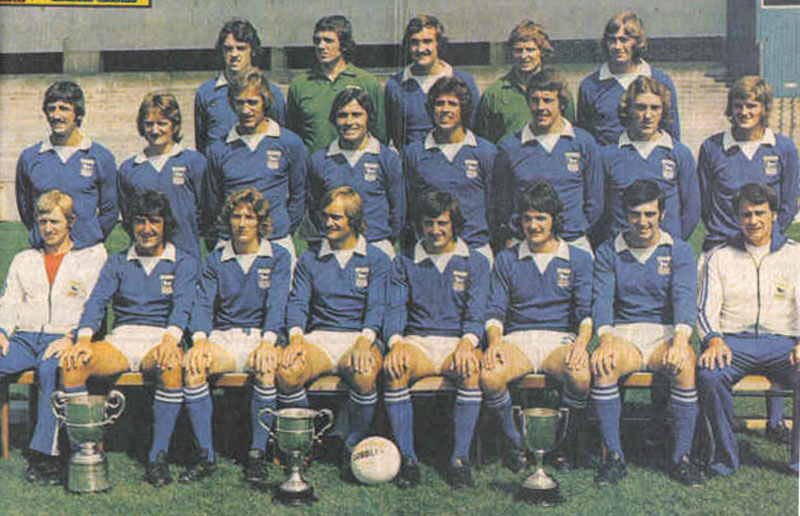
Ten times champions in full glory: top row, from left: Joey Jones, John Toshack, David Fairclough, Ray Clemence, Phil Thompson, Phil Neal.

Middle row: Joe Fagan - coach, Alec Lindsey, Jimmy Case, Ray Kennedy, David Johnson, Roy Evans (2nd trainer), Ronnie Moran (chief trainer)

Sitting: Steve Heighway, Ian Callaghan, Tommy Smith, Bob Paisley (Manager), Emlyn Hughes, Kevin Keegan, Terry McDermott.

By 1977 nothing like 1966: 8 regular English national team players. Ian Callaghan, getting second wind, was recalled to the national team after a long pause. Well, after 1966. Tommy Smith managed to get a single cap in 1971. Toshack and Heighway played for Wales and Eyre. Clemence – Neal, Hughes, Thompson, Case – Kennedy, Callaghan, McDermott – Keegan, Toshack, Heighway: what a squad! With Smith, Lindsay, Fairclough, and new hopefuls Johnson and Jones at the bench. No need to change anything... the replacements were already here for those coming to retirement. Right? Wrong... it was Liverpool. Keegan just became the best European player – who would be crazy to get rid of the biggest international star? Liverpool. They sold him to Hamburger SV right after winning the 10th title. Without a blink. Selling Cruyff was really the end of great Ajax – selling Keegan was nothing for Liverpool: they were yet to win and dominate, and brake records.

Saturday, June 23, 2012

The grueling English season ended badly for three clubs: Sunderland, Stoke City, and Tottenham Hotspur. They finished at the bottom of the table and relegated. Well, one of the best qualities of the English game was precisely in that: no one, big or small, was safe. Glory went hand in hand with peril and often it was impossible to trace a pattern of real decline – a team may have been champion one season and bottom last the next. Yet, there were patterns – Sunderland was a likely candidate for relegation, for the club moved between 1st and 2nd Divisions most of the time. Unsettled, not quite strong and consistent, Sunderland were the usual suspects and generally battled for survival when in 1st Division. No surprise here – they finished 18th and went down.


To a point, Stoke City were no big surprise either: they were modest midtable club, lacking core of great players. Their biggest star was the goalkeeper – Gordon Banks at the beginning of the 70s, eventually replaced by Peter Shilton. How long a goalie can keep a club afloat? It was not that Stoke City did not fight – they finished with only 4 points less than the 13th placed Birmingham City, but in the fierce race for survival these 4 points were the whole difference between life and death.

And after 14 years playing with fire in 1st Division Stoke City moved down. Peter Shilton was going down.... well, not him, as it happened.

At the very bottom finished Tottenham Hotspur. Only few years back the Spurs looked great, winning UEFA Cups. Most of the players were still in the team and perhaps precisely that was the reason for the decline: it was typical English problem during the 70s, although not uniquely English or spesiphic characteristic of this decade. It is classic problem: how to replace a team of great stars, who inevitably aged? Hesitation leads to decline. The English clubs were particularly bad at replacing squads getting old – Manchester United suffered from that and went down, but by 1976-77 there were more following the disastrous example: Leeds United, Manchester City, the Spurs, West Ham United, Chelsea. On paper, they looked fine, but results were increasingly meager. Someone retires and familiar reserve, not very young by now, becomes a starter – but reserves were not going to sufficiently replace the outgoing stars and eventually big crush happens, requiring total makeover. Time was needed to build new efficient team – Manchester United was good example – but there was no guarantee – Chelsea went into a long painful slump. The Spurs evidently came to the point of no return, the crush occurred, they were down, big names and all. The only question was for the future – were they to follow Manchester United's path or Chelsea's? The Spurs had to find the answer in the 2nd Division.

Dead last: sitting from left:Naylor, Coates,Stead, Perrymann, Pratt, Conn, Neighbour, McAllister.

Standing: Jones, Armstrong, Walford, Daines, Burkinshaw – manager, Jennings, Young, Hoddle, Osgood.

Keith Burkinshaw failed in his season with the Spurs. Glen Hoddle, 19-years old, was to experience 2nd Division well before European fame and glory. Poor Pat Jennings...


Up the scale life was brighter: West Bromwich Albion finished 7th, starting a spell of strong years. Aston Villa was getting stronger too, ending at 4th place and scoring the most goals in the league – 76.

Ipswich Town continued their shrewd, consistent improvement - 3rd place this year, only 1 point behind the champions and losing silver medals on goal difference. Ipswich was bettered by Manchester City, who finished second. Their best position since the champion title in 1968. A sweet revenge on their enemy Manchester United, who were 'only' third placed a year earlier.

Tony Book, City's legend from just a few years back, was the manager and everything looked just great: young manager tightly connected with the club seemingly successful. A revival? Escaping the fate of Chelsea and Tottenham Hotspur? At the moment, it appeared to be just that... from the distance of time it was an illusion. The core of the team was still made of veterans Tony Book played with – Colin Bell, Joe Corrigan, Mike Doyle, Gary Owen, Tommy Booth, Glyn Pardoe. Getting old and therefore no better than before. None interested the manager of the English national team anymore. To them were added players with solid reputations: Brian Kidd and Joe Royle. Alas, they were similar to the veterans: experienced, but no longer getting better, just aging. Younger additions – Dave Watson, Dennis Tueart, and Asa Hartford – promised much more, for they were at the peak of their careers. But... with the possible exception of Watson, they were not to be leaders like Colin Bell. Not of the same caliber, particularly Tueart. Peter Barnes was the greatest young hope, only to fade away in the next few seasons. Impressive squad only on paper and not one to carry on for long: retirement and moving to USA and West Germany (Watson) happened to be the near future. In a way, it was the last spurt of greatness for the Citizens, masking for the moment the real story – decline. If the boys were five years younger... but they were not. At least they 'died' in style.

Wednesday, June 20, 2012

Second Division ended with familiar names on top. Wolverhampton Wanderers claimed 1st place.


As if to prove that they were down only by freak accident, the Wolves returned to top flight just a year after suffering relegation. Chelsea grabbed second place, returning to 1st Division a bit slower than the Wolves – after two seasons down.

Going up, but it was not really a winning squad – Chelsea already entered their long dark years, and this success was a bit misleading.

Third finished a club, which attracted little interest: Nottingham Forest.


Apart from Brian Clough, so far Forest was hardly impressive squad. Good they were returning from exile since 1972, but not exactly the team to shake 1st Division. Yet, since Clough was coaching them, they were expected to be fighters. No more. No more at the end of 1976-77 season. What possibly can be expected from a team barely clinching the last promotional spot. So far, it was not the unknown Viv Anderson, but John O'Hare defining the team: Clough was dragging him with himself, but no matter how valuable he was for Clough, O'Hare was hardly a star.

Monday, June 18, 2012

In 3rd Division Mansfield Town finished first, but the next clubs in the final table were more interesting:

Brighton & Hove Albion finished second, three points behind the champions.

Not exactly a team to brag about, but these boys were to go even higher and soon.

Third was Crystal Palace, quite shaky club, which not so long ago, in 1972, was proud member of 1st Division. The steep decline eventually halted and now the Londoners were lifting up their heads again. Not so brightly yet – they finished 3rd, enough for promotion.
Their climb was not to end just with this promotion, but unlike Brighton & Hove, not to mention Mansfield, Crystal Palace had already two persons who were soon to play major roles not only in English football: one young left full-back named Kenny Sansom and another young man – their manager Terri Venables. Just wait a few more years.

Saturday, June 16, 2012

England. To a point, lagging behind Germany. Structurally, conceptually, and financially. England was slow to change its ways – tactical innovations did not happen; money were getting alarmingly short; stadiums were getting increasingly old and shabby; there was no vision for training kids new kind of game. All of that was becoming clear only when compared to the West Germans – most of Europe, including Italy and Spain, was in similar conditions, so it was not painfully obvious that English football was ill prepared for the future. The alarm came from another source: rapidly increasing violence among fans. So far there was no concept what to do with the phenomenon, so it just grew. There was even fascination with that, especially outside the British Isles – it was not long before the violent fan culture spread everywhere. Yet, English football preserved its competitive edge and continued to keep its entertaining standards. Which probably contributed to the painfully slow realization of the need for fundamental changes.


Anyhow, lets begin from the bottom. Cambridge United won the 4th Division, moving up to 3rd for the next season.

4th level football hardly makes big news and therefore there is next to nothing to say about the players. No big stars here, past, present, or future ones. However, Cambridge started its climb this year and more than maintained a momentum, but, of course, nobody was really able to envision that. One thing should be mentioned, though: Cambridge was the club with best record among all professional English clubs: out of 46 seasonal games, they won 26 and lost only 7.