Ranking, always relative and unconvincing, at the end is subjective matter. To me, French football quietly survived its crisis and after 1975 was steadily on the rise. Talented new players emerged, but since French clubs never had the kind of money Italians and Spaniards had 'big' clubs did not develop. At least not in European sense. French football continued to be pleasant and kind of unpredictable – talent was scattered, making teams fairly equal. The championship was not any other – clubs performing well this year may be relegated the next. Unlike England, where rise and fall were gradual, in France it was sudden. Yet, instability did not prevent development and by 1976 there were clear signs of general ascent. Of course, it was not obvious in real time, but seen better from a distance. Three clubs won promotion at the end of 1976-77 season. Familiar names.
AS Monaco won Group A of the Second Division. It was fairly quick return from 'exile', but Monaco were not overwhelming champions. Rather, their return was shy – their record was hardly great, having neither the best defense, nor the best strikers in Group A. They finished 3 points ahead of second placed FC Gueugnon.
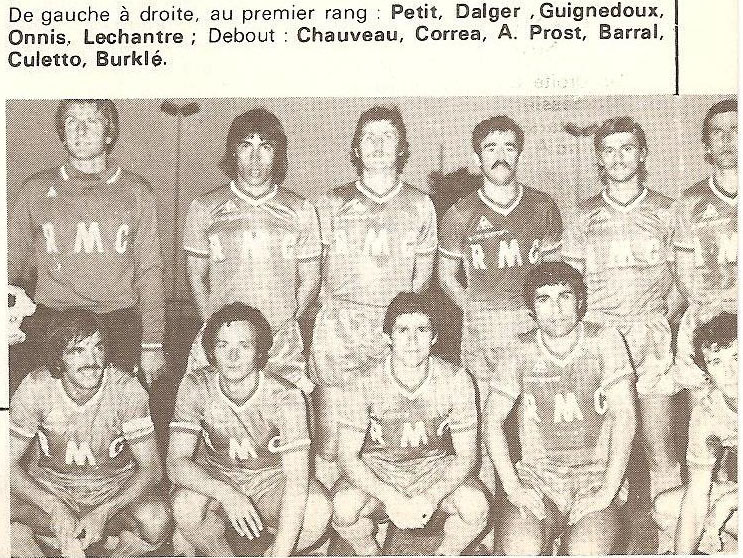
Returning to First Division after two years of misery. Delio Onnis was the best scorer of Group A with 30 goals – no matter which division the Argentine played in, he scored and scored. Chauveau was reliable between the goalposts – the experienced goalkeeper, still ranked among the best in France, may have been surprised to play second division football, but he was coming back. So was the other deadly striker – Dalger. Still second division player in the first half of 1977, Dalger was going to play at the 1978 World Cup. Add the team captain Petit – the 'skeleton' of Monaco was strong, providing for building of better team around it.
RC Strasbourg won the Group B, another familiar name, returning to its 'rightful' place. Unlike Monaco , Strasbourg really dominated their league. With 84 goals they outscored by far everybody else, but their defense was no joke as well – it was also the best: only 26 goals in 34 games. Strasbourg did not have to fret – they finished confidently, 5 points ahead of nearest pursuer.
Like Monaco, Strasbourg had strong 'skeleton' of players who hardly belonged to second division: the future famous coach Ivica Osim and the former member of the great Ajax, Schilcher, were the foreigners. Dropsy between the posts, who was to go all the way from second division to the national team. Albert Gemmrich, well known name at the time, added strength to the attack – he ended as the best scorer of the league with 24 goals. Like Monaco, Strasbourg seemingly had good chance to become a force.
Second in Group B finished another familiar name – FC Rouen. They won the play-off for the third promotional spot and also returned to first division football.
Standing: Armando Bianchi, Joannes, Lemaître, Polny, Amouret, Guillolet, Bienaimé, Vitulin, Gili, Jouanne, Pancho González.
First row: Bansaye, Carrié, ???, Weiss, Poli, Bourebbou, Horlaville, Peña, Jorge Trezeguet.
Unlike Monaco and Strasbourg, Rouen did not have cluster of stars. From the distance of time, one player catches attention: Trezeguet. Familiar name? Well, this one could be only by association – he is the father of the superstar David Trezeguet. Having the father did not make Rouen stronger team – given their record, Rouen was likely to fight only for survival in the first division. As for Monaco and Strasbourg – just wait one year. Both teams were to contribute to the general improvement of French football.
Monday, July 16, 2012
Saturday, July 14, 2012
Torino ruled the championship, Milano got a bit of revenge in the Cup: Milan and Inter reached the final. With rivalry so bitter, Torino was hardly on the mind – there was archenemy at hand. Of course, it looked like the big boys were strong and around as ever, but in reality it was more of hanging to old ways. Old, tired teams suffered during the grueling championship – direct elimination in the Cup format they were able to muster and go ahead. Experience seemingly was enough only for that and no more. Old ways were still dominant, but... it was more a picture of the 1960s than from the second half of the 1970s. Rivera vs Facchetti. Mazzola was still around. The word 'boring' is not even right... although it was touching in way: at least veterans like those going down in style is always sweet. Sweet, and no more – for no matter how bitter the rivalry was, the outdated teams were no longer entertaining.
Anyhow, Milan won 2-0.
At the losing end this year: Inter finished outside the top three at the championship, and lost the Cup. And looking at the squad, it was clear that the future would be trouble – Facchetti, Mazzola, Anastasi were yesterday at best. Merlo, Muraro, Libera, Fedele... that's the future?
Milan mirrored Inter: Rivera, Albertosi, Capello at their last legs and tomorrow's team based on Calloni, Vincenzi, Silva? Well, at least Milan had Collovati for tomorrow... was he the whole difference between Inter and Milan? Milan had disastrous season, finishing at the unseemly 10th place. At least they gathered some strength and ambition to win the Cup.
It was almost surprising Milan were able to run around the stadium with the trophy – but never mind. They won and was great to rub Inter's noses once again. It was great for the club and its supporters, for it was quite clear trophies were getting scarce. It was great for Rivera, getting upper hand over Mazzola and Facchetti. It was great for Capello – at least he won something with his new team, unlike his former Juventus teammate Anastasi. And it was bitter end for Mazzola, who retired this year empty handed, on the losing side.
Wednesday, July 11, 2012
The bulk of the Italian league continued to follow tradition: try to win at home and may be get a point away. Roma, right at the middle of the table (8th place) got 23 points at home, better than the bronze medalist. However, they did not win a single away match, losing 10 and tying 5. That is, Roma got the same points away as the last placed Cesena. No wonder stagnation reigned, gradually leading to hopeless decline – Cagliari was already in 2nd Division, Sampdoria joined them, Milan finished at 10th place. Inter did not look better either – they finished 4th, but their total points made them closer to the midtable rabble than to the top clubs: 33 points. Foggia ended with 7 points less than Inter at the 13th place. However, Torino finished with 17 points more than Inter. Of course, one may say it was the competitive nature of Italian football, it was so tough to win. Well, it was tough to win indeed, if you only think how to tie a match and get a point.
Fiorentina finished with bronze medals. The top of the bulk – total of 33 points were good enough for third place. Two points more than Inter. 12 wins (2 more than Foggia), 11 ties (like Lazio, Peruggia, Napoli, Genoa, and Bologna). Fiorentina scored 38 goals in 30 games; received 31. Only three clubs scored more Fiorentina. Five clubs had stronger defense. But... a team scoring practically one goal on average finished at third place.
Yet, it was good season for Fiorentina – bronze medals are hard to get in Italy. The squad dies not look like revelation, but there was a new breed of star, already captaining the team – Antognioni. Seemingly alone in this squad, but already making big difference – the difference between 3rd and 4th place. A tiny ray of light.
Above Fiorentina finished Torino. They were concerned with competition from behind, their only concern was ahead: Torino finished 15 points above Fiorentina. They ended with the best attack, scoring 51 goals; best defense, allowing only 14 goals; and best goal difference. Alas, one point deprived them from repeating the success of 1975-76. This time – vice-champions.
Torino had pretty much the same squad as the year before. A well balanced squad in its prime, but not precisely superteam, going to conquer the world. Yet, Torino grasped better the changes in European football and the Italian stagnation: they built a team of relative unknowns, younger players, who made their names playing for Torino, and eventually winning. The club did not try to 'fortify' the squad with famous veterans – and their previously unknown boys paid back with strong performance. Unfortunately, it was not a team to last, even less building a dynasty: it was more of a transitional team, fit for the time of stagnation, carrying a bit of new ideas through troubled times, and generally making a road for others.
Juventus did not have to make path for others: they already went ahead for themselves. They were quicker to realize that adjustment to the new tendencies in European football was a must; did that, rebuilt the team, changed the coach with young guy, without old habits and suffering from traditional ways. Juventus was the only improving Italian team, and to a point they came to maturity in 1976-77. Their title was won after difficult race against Torino and was clinched by only a point, but in terms of squad and play, it was clear Juventus were the team of the future.
Familiar names surely. Well balanced squad. Nothing sentimental about the club's policy: a mixture of high profile stars, experienced players at their prime, and rapidly improving youngsters. By this season Scirea, Gentile, Cuccureddu were already firm starters, even more – they were stars. The future was really Cabrini, pushing for a place among the first eleven. It was not easy to get a spot among the first eleven in a squad bursting with talent: apart from Dino Zoff, nobody else was sure of his place. But, being an Italian team, Juventus depended on firm starting team, which was, with the number of games played during the season in brackets: Zoff (30); Cuccureddu (29), Gentile (29); Furino (26),
Morini F. (26), Scirea (30); Causio (30), Tardelli (28),Boninsegna (29), Benetti (30), Bettega (30). Five players did not miss a single game; another three missed only one match during the whole grueling season – talk about stability. Talk about sentimentality too – rather, the lack of it. Spinosi and Gori were starters only a year or two back. Anastasi and Capello were gone – replaced by people from the camps of archenemies: Boninsegna from Inter and Benetti from Milan. Damiani, the 'revelation' just a year back, was out unceremoniously. Juventus was building team to last on top, not paying any sentimental dues to stars no longer fitting into the concept, no matter how big and venerated the names. The new god was Bettega, reaching his prime. Causio and Furino were more or less the drivers, shakers and makers, of the team's game, and the bunch of youngsters was almost ready to take the reigns at any minute – it was obvious that Gentile, Scirea, and Tardelli are to lead the team in a year or two, the future was ensured. But he biggest guarantee of bright future was the new coach: Giovanni Trapattoni. It was his first title as a coach. He was 37 years old and Juventus was his first professional team coaching. Juventus obviously was looking for the future and risked with young and inexperienced, but because of that – a coach unburdened and free from stagnating tradition. The risk was more than worthy – Trapattoni won the title in his very first year. Just a taste, just a beginning. Oh, yeah... it was only the 17th title for Juventus. Business as usual... Inter had 11 and Milan – measly 9. Time to conquer Europe.
Fiorentina finished with bronze medals. The top of the bulk – total of 33 points were good enough for third place. Two points more than Inter. 12 wins (2 more than Foggia), 11 ties (like Lazio, Peruggia, Napoli, Genoa, and Bologna). Fiorentina scored 38 goals in 30 games; received 31. Only three clubs scored more Fiorentina. Five clubs had stronger defense. But... a team scoring practically one goal on average finished at third place.
Yet, it was good season for Fiorentina – bronze medals are hard to get in Italy. The squad dies not look like revelation, but there was a new breed of star, already captaining the team – Antognioni. Seemingly alone in this squad, but already making big difference – the difference between 3rd and 4th place. A tiny ray of light.
Above Fiorentina finished Torino. They were concerned with competition from behind, their only concern was ahead: Torino finished 15 points above Fiorentina. They ended with the best attack, scoring 51 goals; best defense, allowing only 14 goals; and best goal difference. Alas, one point deprived them from repeating the success of 1975-76. This time – vice-champions.
Torino had pretty much the same squad as the year before. A well balanced squad in its prime, but not precisely superteam, going to conquer the world. Yet, Torino grasped better the changes in European football and the Italian stagnation: they built a team of relative unknowns, younger players, who made their names playing for Torino, and eventually winning. The club did not try to 'fortify' the squad with famous veterans – and their previously unknown boys paid back with strong performance. Unfortunately, it was not a team to last, even less building a dynasty: it was more of a transitional team, fit for the time of stagnation, carrying a bit of new ideas through troubled times, and generally making a road for others.
Juventus did not have to make path for others: they already went ahead for themselves. They were quicker to realize that adjustment to the new tendencies in European football was a must; did that, rebuilt the team, changed the coach with young guy, without old habits and suffering from traditional ways. Juventus was the only improving Italian team, and to a point they came to maturity in 1976-77. Their title was won after difficult race against Torino and was clinched by only a point, but in terms of squad and play, it was clear Juventus were the team of the future.
Familiar names surely. Well balanced squad. Nothing sentimental about the club's policy: a mixture of high profile stars, experienced players at their prime, and rapidly improving youngsters. By this season Scirea, Gentile, Cuccureddu were already firm starters, even more – they were stars. The future was really Cabrini, pushing for a place among the first eleven. It was not easy to get a spot among the first eleven in a squad bursting with talent: apart from Dino Zoff, nobody else was sure of his place. But, being an Italian team, Juventus depended on firm starting team, which was, with the number of games played during the season in brackets: Zoff (30); Cuccureddu (29), Gentile (29); Furino (26),
Morini F. (26), Scirea (30); Causio (30), Tardelli (28),Boninsegna (29), Benetti (30), Bettega (30). Five players did not miss a single game; another three missed only one match during the whole grueling season – talk about stability. Talk about sentimentality too – rather, the lack of it. Spinosi and Gori were starters only a year or two back. Anastasi and Capello were gone – replaced by people from the camps of archenemies: Boninsegna from Inter and Benetti from Milan. Damiani, the 'revelation' just a year back, was out unceremoniously. Juventus was building team to last on top, not paying any sentimental dues to stars no longer fitting into the concept, no matter how big and venerated the names. The new god was Bettega, reaching his prime. Causio and Furino were more or less the drivers, shakers and makers, of the team's game, and the bunch of youngsters was almost ready to take the reigns at any minute – it was obvious that Gentile, Scirea, and Tardelli are to lead the team in a year or two, the future was ensured. But he biggest guarantee of bright future was the new coach: Giovanni Trapattoni. It was his first title as a coach. He was 37 years old and Juventus was his first professional team coaching. Juventus obviously was looking for the future and risked with young and inexperienced, but because of that – a coach unburdened and free from stagnating tradition. The risk was more than worthy – Trapattoni won the title in his very first year. Just a taste, just a beginning. Oh, yeah... it was only the 17th title for Juventus. Business as usual... Inter had 11 and Milan – measly 9. Time to conquer Europe.
Monday, July 9, 2012
Italy at crossroad: this season was practically Torino fight. Rarely, if at all, there was only2-team race in Italy, leaving everybody else far, far behind. The unusual situation suggested that the crisis was deepening. On the other hand the national team showed signs of life and new stars were popping in here and there. Italian football appeared to be sharply divided, but optimism laid solely with Juventus. The rest was able to show only a handful of new breed players scattered among the league. Old habits were slow to die. The second division was tightly contested with 5 clubs furiously competing for three promotions – Cagliari were the losers: they finished 4th because of worse goal difference. Behind them ended Monza, only 3 points less than the champions. Atalanta finished 3rd and Pescara 2nd – with equal points, 49 each. First place went to L.R. Vicenza, finishing with 51 points. Not really great addition to 1st Division – the newcomers were familiar names, normally moving between first and second division, and hardly clubs to create sensations. But there was a player ready to burst and already getting attention: Paolo Rossi, the young striker of L.R. Vicenza.
The bottom of 1st Division was occupied by Cesena, Catanzaro, and Sampdoria. Sampdoria was a bit of a surprise – at least by name, hardly the club to be relegated, but they were, joining Cagliari in the lower division. Well, when clubs like Sampdoria were good only for going down, the crisis of Italian football was acute and may be permanent. The other two clubs were no surprise, especially Cesena, who won only 3 matches during the season and collected measly 14 points, seven less than the 15th placed Catanzaro.
Cesena – the lowest of the low. Dead last.
Just above relegation zone finished Foggia - lucky 13th place, 2 points better than Sampdoria and securing one more season of struggle in 1st Division. To a point, Foggia were the typical Italian team of the time: if there was anybody more or less famous player, he was likely to be aging. Bergamaschi, in the case of Foggia.
But Foggia deserves mentioning for another reason: they survived thanks to winning games, 10 in total. Only 5 other teams finished with 2-digit number of wins – the top five. Inter and Lazio won the same number as Foggia. Winning was survival, winning was the future. Yeah, right... try telling that to 11 of the 1st Division clubs, who professed the old Italian wisdom: not winning, but ties spell out survival. 11 clubs ended with more than 10 ties, the record belonged to Milan with 17 tied games out of 30 seasonal matches. Only the very top and the very bottom of the league had less than 10 ties – playing for more than a point was risky affair, something like Russian roulette: you may win big. Or die.
Saturday, July 7, 2012
The real disturbing news of the season was Real Madrid – contrary to expectations, they had terrible season and finished at 9th place. Hard to tell why: the same team with the same coach won the two previous seasons. It was not aging squad – it was just in its prime. May be the absence of Netzer? Hardly – he was getting old and going downhill. Whatever it was, Real was a disaster, and the remedy was familiar all over the world: the coach was sacked. Two titles in two years? So what? Did he win THIS year? Good bye Miljanic. Good bye Breitner too.
Good fortune came to other clubs: Athletic Bilbao finished third. The Basques looked like they were coming back to the very top of Spanish football, may be beginning a new and long waited strong spell.
Athletic reached the final of the UEFA Cup, reached the final of Copa del Rey, and finished with bronze medals the championship. They were not ripe for success yet, for they ended 7 points behind the 2nd placed team, not contenders for the title at all, but improving. May be next year?
The race for the title was between two teams and was tough: a single point divided champions from vice-champions. The silver boys finished with better goal difference and were the points equal, the champions were to be different. But point is a point and Barcelona lacked that point.
Rinus Michels evidently sparked the Catalans, but still came a little short. May be there was no more to be extracted from this squad. Cruyff and Neeskens were the grand masters, but both were a bit bellow their performance from few years back. Rebuilding of the team already started and was painful – somehow no great new player emerged, and veterans were still essential. One big problem was goalkeeping, where the crisis was acute. Michels managed to extract one last spurt, one last run, but it was clearly ailing team. At the end, it was in the mouth of Cruyff – he seemingly was immune to firing, so revolution was possible only if he decided to leave.
The unexpected fall of Real Madrid and the well known handicaps of Barcelona opened opportunity for Atletico Madrid. And they did not miss it – Atletico fought and managed to edge Barcelona and win the title.
Here they are before the start of the season in 1976.
And in May 1977 – champions! Not a single fan of Atletico would say that this team was no good and I prefer Atletico than Real, but this is not a champion squad. Not a team going to build a dynasty. It was more similar to Barcelona of that season, not like Real. Like Barcelona, it was experienced, stable, but dangerously aging squad. The movers and shakers were almost the same, who won the Spanish title in 1973. Replacing them was a problem, for somehow no new great player was emerging. Like Barcelona, Atletico depended heavily on their foreigners – Ayala, Leivinha, and Luis Pereira. By now everybody in Spain knew them well and countermeasures were well in place. The three were stars indeed, but it was amply telling that none was invited to play for their national teams anymore. For this squad it was the last hurray, and may be they were just lucky this year – the slip of real Madrid left only Barcelona, a fight of pretty much equal veterans. As good as a victory was, it was quite clear success was not going to be continued.
Spain appeared stilled, but there was at least somebody suggesting brighter future: Mario Kempes, playing for Valencia, was the best goalscorer of the season with 24 goals.
Already a star, he was going up – superstardom was to come in 1978. Kempes, unlike the rest of venerated foreigners in Spain, was younger, just approaching his best years.
Wednesday, July 4, 2012
Real Betis had strong season – not only winning Copa del Rey, but also finishing 5th in the championship. Sevilla FC ended way down, at 10th place, but it was nothing like the misery at the bottom of the table: Real Zaragoza, RC Celta, and CD Malaga finished at the last three spots and were relegated.
Misery in Vigo – Celta going down. No wonder even he picture is ugly.
The unfortunates were to be replaced by happy winners, promoted from the 2nd Division:
Sporting (Gijon), the winners of Segunda Division, returning to Primera. They had a star, a real one: Quini – a natural goalscorer, tough, big, fearless. Here he is in the middle with the ball, but he was destined for bigger clubs and bigger success than promotions from 2nd Division.
Cadiz CF finished at second place in Segunda and went up – like Gijon, returning to Primera, but Cadiz were likely just to stay near the bottom of the table, fighting to survive.
The same was the case of third promoted club: Rayo Vallecano. They are the third club from Madrid, dwarfed by Real and Atletico, and generally a novelty – rarely playing top level football, Rayo Vallecano were not expected even to survive in Primera, let alone challenging the big neighbours.
And that was the bottom, where movements happened, but hardly the relegated were to be missed and the newcomers were not exactly clubs to disturb the status quo.
Monday, July 2, 2012
Spain had perhaps the third strongest championship in 1976-77 – lagging behind West Germany and England for sure, but in my opinion a bit better than the Italians. May be just a bit stronger. By now transfers to Spanish clubs were not he biggest news in Europe – more or less, the biggest clubs depended on foreign stars already settled in Spain. Barcelona kept Cruyff and Neeskens, but rehired Rinus Michels to coach them again. Cruyff was clearly saying who should be the coach, which was fine, but the aging team had to be rebuild and the process was not exactly smooth. Real Madrid kept Milan Miljanic, for he was so far successful, but Gunter Netzer moved out in the summer of 1976. He joined Grasshopper (Zurich). Real Madrid replaced him with another Borussia (Moenchengladbach) player – Henning Jensen, the Danish centerforward, who already became a star in Germany. He and Paul Breitner were thought to be enough for another title. The rest of the Spanish clubs seemingly did not make big changes, if any. Judging by the lack of impressive transfers, the season was kind of predictable – the usual Real-Barcelona duel, in which Madrid appeared to have the edge. The major change was the name of the national cup – with Franco dead, it was no longer to be named after him. The original name was restored – the King's Cup. But... that is the shortcut in English: the trouble of tournaments named after a royalty is the reigning monarch: with the restoration of Spanish monarchy, mere sports tournament had to take the name of the actual King. Thus, the name was practically brand new: Copa del Rey is really named Copa de S. M. Rey Don Carlos I. It was simultaneously the old traditional tournament and brand new. No matter, national cup it was and there was a crack: neither Real Madrid, nor Barcelona reached the final. Athletic Bilbao and Real Betis (Sevilla) were the contenders for the cup with new name.
Athletic Bilbao were in good shape this season, and so were Real Betis, but the Basques looked stronger, at least traditionally stronger club.
Top row, from left: Iribar, Astrain, Goicoechea, Escalza, Villar, Lasa.
Kneeling: Churruca, Irureta, Dani, Garay, Rojo I.
No foreigners, no Spaniards, the usual tough bunch of Basques. Iribar, Irureta, may be Villar provided class. Normally a gritty team, Athletic had new villain – Goicoechea. The world did not know of him yet, but it would and soon. Anyhow, Bilbao had strong season and the Cup was likely to go to them.
But the final ended 2-2 after overtime and had to be decided by penalty shoot-out. The contestants went goal for goal until finally Athletic missed, and Real Betis won by 8-7. Nothing for the Basques, Cup for the Andalusians. A final leading to heart attacks, but to a point it was good – the underdogs won, I like that.
Here they are – Cup winners without a single star. Burly guys... or determined? Or plain tired? Smiles are not their forte, but smiles alone do not win trophies. It was their first ever Cup and only second title so far. Coming after overtime and grueling 21 penalties! And how good to be back home, displaying the Cup in the faces of arch-rivals Sevilla FC!
Subscribe to:
Posts (Atom)


